Thursday, May 31, 2007

The Visitation of the Blessed Virgin Mary

From here:
After the angel Gabriel had announced to Mary that she was to become the mother of Our Lord, Mary went from Galilee to Judea to visit her kinswoman Elizabeth, soon to be the mother of John the Baptist. This visit is recorded in Luke 1:39-56. Elizabeth greeted Mary with the words, "Blessed are you among women, and blessed is the fruit of your womb." Mary burst forth with the song of praise which we call the Magnificat, beginning, "My soul proclaims the greatness of the Lord." We are told that even John the Baptist, still unborn, leaped for joy in his mother's womb. Thus we are shown, side by side, the two women, one seemingly too old to have a child, but destined to bear the last prophet of the Old Covenant, of the age that was passing away; and the other woman, seemingly not ready to have a child, but destined to bear the One Who was Himself the beginning of the New Covenant, the age that would not pass away.

It is this meeting that we celebrate today.

Wednesday, May 30, 2007

Pine Gap 4 Vigil

The trial of the Pine Gap 4 was due to begin yesterday, so we did a vigil in Bourke Street Mall to pray for them and express our solidarity as they face a possible seven year jail term. We also thought it would be good to do it in public to raise some awareness of Pine Gap and the trial itself. It turned out to be more of a conversion experience for us than for any of the passersby.

Simon talks with Brent and Marcus.

Our banners - drawing attention to the trial and to the role of Pine Gap in Iraq.

Some of our crew attempting to hold the banner up in the wind.

Lorien and Christop take their turn to read the names of those killed in Iraq. It was a deeply moving experience.

A family affair! Paul Jameson and I brought our kids along, which made it all the more significant.

My turn to read the names.

We met up around 11 and talked a bit about what we were there for and how we were going to go about reading the names. Then we walked over to Bourke Street and picked a spot right outside the Myer entrance.

Most people walked past us, of course - we reflected later on some ways we could have engaged people better, but for the moment I was content just not to be pushy, and let people come to us if they were interested. And they did - we had quite a few people approach us and ask what it was about. A few people knew about Pine Gap, but not many. The last guy we talked to was actually a doctor from Alice Springs, many of whose patients work at the base. So that made for an interesting discussion.

Mostly though it was useful for us to do this: reading the names out had a particularly significant effect on us all. We read the names, ages, occupations, date they were killed, how they were killed, and where, of both coalition and Iraqi casualties. We wanted to do both to bring a sense of balance and recognise that there are victims on both sides of a war. The emotions it evoked were intense. I went through despair, sadness, frustration, anger, peacefulness. Often it depended on which list I was reading - it was harder to feel sympathy for the coalition casualties, who you knew were there to do a job, and who were there intentionally. Whereas for the Iraqi list, made up mostly of civilians, it was much more poignant; especially when you're acknowledging the deaths of children, unborn babies in their pregnant mothers, farmers, mechanics - not soldiers. Even still, most of the coalition dead were under 24; many as young as 18 and 19. For us it was really as much about repentance as anything - not flagellation, but recognition and genuine regret and solidarity. Realising how complicit we all are in this system of violence and destruction - confessing and repenting of it.

So this turned out to be much more for our good than for anyone else's. And the sense I was left with is that there's such a long way to go. We barely scratched the surface - maybe read 2 or 3 hundred names - of somewhere in the ballpark of 650,000 casualties. The pain of this and the legacy of destruction cannot even begin to be touched. But we've begun.

Some Christop photos here.

more pasted street art

Seeds for Pentecost

Well, a bunch of us from inspiral, Footscray, Bendigo and Norlane headed up to the You Yangs on Sunday for a gathering of the clans...lots of kids, a beautiful spot and wonderful people. Here's a pictorial tour of the day:

Marx leads as only Marx can.

Chelsea decided we were at "Bear Rock", and thought it was the best thing ever. At one point, when she looked out at the view, she gasped and exclaimed, "Look at that big world!" (I was tempted to say, "No darling, that's just Geelong," but didn't want to disappoint her.)


Some of the gathered clan. Check out the view of the big world in the background.

The sky was doing some pretty cool things.

The view from the other direction.

We headed back to Norlane afterwards for afternoon tea. Great to hang out with this bunch, and I only wish more of our mob were there.

no no...not THOSE B-52s...

Tuesday 22 May, at Bristol Crown Court, the trial of two Oxford peace activists Philip Pritchard and Toby Olditch (known as the 'B52 Two') concluded with the jury returning a unanimous verdict of not-guilty- in less than three hours. The two were charged with conspiring to cause criminal damage at RAF Fairford in Gloucestershire on 18 March 2003 when they tried to safely disable US B52 bombers to prevent them from bombing Iraq. The court heard the two men acted to prevent damage to life and property in Iraq, and war crimes by the aggressors.

The trial started on Monday 14 May 2007. This is the second trial for the alleged offence; the first in October 2006 ended in a hung jury, after 12 hours of deliberation spread over three days. The two accused were facing up to ten years in jail. There are two other similar cases awaiting re-trial, due to hung juries, at Bristol crown court.

The two activists maintain that war crimes were committed in the bombing as cluster bombs, which spread unexploded bomblets that kill and maim civilians (like mines) were used, as were 'bunker busting' bombs tipped with depleted uranium that fragments, spreading radioactive toxins which are harmful to civilians.

During the trial the prosecution accepted that even delaying the bombers would have prevented civilian casualties, as it would have allowed those fleeing cities more time to escape. In his hour and a half summing up today, Justice Crowther explained the legal tests that must be met for the prosecution to succeed, he reiterated the facts and summarised the evidence. A document 'steps to verdict' had been provided to assist the jury.

Toby Olditch said "We're overjoyed, and thankful for the good sense of the jurors, for the wonderful support we've received, and for the commitment and expertise of our legal representatives. But hundreds of thousands of Iraqi people have still suffered as a result of the Government's actions. It shouldn't have come to the point that people had to take direct action to try to check the abuse of executive power."

Phil Pritchard "I am delighted that the jury have returned a unanimous not-guilty verdict. Our action in trying to prevent illegal attacks on the people of Iraq in 2003 is vindicated. I hope war of this kind never happens again."

Friday, May 25, 2007

St Philip Neri

From here: Philip Neri was a sign of contradiction, combining popularity with piety against the background of a corrupt Rome and a disinterested clergy, the whole post-Renaissance malaise.

At an early age, he abandoned the chance to become a businessman, moved to Rome from Florence and devoted his life and individuality to God. After three years of philosophy and theology studies, he gave up any thought of ordination. The next 13 years were spent in a vocation unusual at the time—that of a layperson actively engaged in prayer and the apostolate.

As the Council of Trent was reforming the Church on a doctrinal level, Philip’s appealing personality was winning him friends from all levels of society, from beggars to cardinals. He rapidly gathered around himself a group of laypersons won over by his audacious spirituality. Initially they met as an informal prayer and discussion group, and also served poor people in Rome.

At the urging of his confessor, he was ordained priest and soon became an outstanding confessor, gifted with the knack of piercing the pretenses and illusions of others, though always in a charitable manner and often with a joke. He arranged talks, discussions and prayers for his penitents in a room above the church. He sometimes led “excursions” to other churches, often with music and a picnic on the way.

Some of his followers became priests and lived together in community. This was the beginning of the Oratory, the religious institute he founded. A feature of their life was a daily afternoon service of four informal talks, with vernacular hymns and prayers. Giovanni Palestrina was one of Philip’s followers, and composed music for the services.

The Oratory was finally approved after suffering through a period of accusations of being an assembly of heretics, where laypersons preached and sang vernacular hymns! (Cardinal Newman founded the first English-speaking house of the Oratory.)

Philip’s advice was sought by many of the prominent figures of his day. He is one of the influential figures of the Counter-Reformation, mainly for converting to personal holiness many of the influential people within the Church itself. His characteristic virtues were humility and gaiety.

Thursday, May 24, 2007

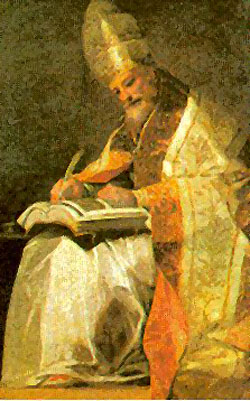
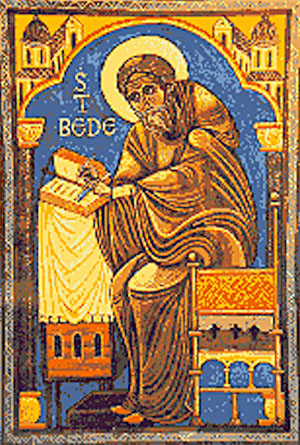
St Gregory VII, St Mary Magdalen of Pazzi, and St Bede the Venerable

St Gregory VII - from here: The tenth century and the first half of the eleventh were dark days for the Church, partly because the papacy was the pawn of various Roman families. In 1049, things began to change when Pope Leo IX, a reformer, was elected. He brought a young monk named Hildebrand to Rome as his counselor and special representative on important missions. He was to become Gregory VII.

Three evils plagued the Church then: simony (the buying and selling of sacred offices and things), the unlawful marriage of the clergy and lay investiture (kings and nobles controlling the appointment of Church officials). To all of these Hildebrand directed his reformer’s attention, first as counselor to the popes and later (1073-1085) as pope himself.

Gregory’s papal letters stress the role of bishop of Rome as the vicar of Christ and the visible center of unity in the Church. He is well known for his long dispute with Holy Roman Emperor Henry IV over who should control the selection of bishops and abbots.

Gregory fiercely resisted any attack on the liberty of the Church. For this he suffered and finally died in exile. He said, “I have loved justice and hated iniquity; therefore I die in exile.” Thirty years later the Church finally won its struggle against lay investiture.

St Mary Magdalen of Pazzi - a vow of virginity at age 10 and she's still called "the ecstatic saint"? - from here: Mystical ecstasy is the elevation of the spirit to God in such a way that the person is aware of this union with God and both internal and external senses are detached from the sensible world. Mary Magdalene de Pazzi was so generously given this special gift of God that she is called the "ecstatic saint."

She was born into a noble family in Florence in 1566. The normal course would have been for Catherine de Pazzi to have married wealth and enjoyed comfort, but she chose to follow her own path. At nine she learned to meditate from the family confessor. She made her first Communion at the then-early age of 10 and made a vow of virginity one month later. When 16, she entered the Carmelite convent in Florence because she could receive Communion daily there.

Catherine had taken the name Mary Magdalene and had been a novice for a year when she became critically ill. Death seemed near so her superiors let her make her profession of vows from a cot in the chapel in a private ceremony. Immediately after, she fell into an ecstasy that lasted about two hours. This was repeated after Communion on the following 40 mornings. These ecstasies were rich experiences of union with God and contained marvelous insights into divine truths.

As a safeguard against deception and to preserve the revelations, her confessor asked Mary Magdalene to dictate her experiences to sister secretaries. Over the next six years, five large volumes were filled. The first three books record ecstasies from May of 1584 through Pentecost week the following year. This week was a preparation for a severe five-year trial. The fourth book records that trial and the fifth is a collection of letters concerning reform and renewal. Another book, Admonitions, is a collection of her sayings arising from her experiences in the formation of women religious.

The extraordinary was ordinary for this saint. She read the thoughts of others and predicted future events. During her lifetime, she appeared to several persons in distant places and cured a number of sick people.

It would be easy to dwell on the ecstasies and pretend that Mary Magdalene only had spiritual highs. This is far from true. It seems that God permitted her this special closeness to prepare her for the five years of desolation that followed when she experienced spiritual dryness. She was plunged into a state of darkness in which she saw nothing but what was horrible in herself and all around her. She had violent temptations and endured great physical suffering. She died in 1607 at 41, and was canonized in 1669.

St Bede - from here: Bede is one of the few saints honored as such even during his lifetime. His writings were filled with such faith and learning that even while he was still alive, a Church council ordered them to be read publicly in the churches.

At an early age Bede was entrusted to the care of the abbot of the Monastery of St. Paul, Jarrow. The happy combination of genius and the instruction of scholarly, saintly monks produced a saint and an extraordinary scholar, perhaps the most outstanding one of his day. He was deeply versed in all the sciences of his times: natural philosophy, the philosophical principles of Aristotle, astronomy, arithmetic, grammar, ecclesiastical history, the lives of the saints and, especially, Holy Scripture. From the time of his ordination to the priesthood at 30 (he had been ordained deacon at 19) till his death, he was ever occupied with learning, writing and teaching. Besides the many books that he copied, he composed 45 of his own, including 30 commentaries on books of the Bible.

Although eagerly sought by kings and other notables, even Pope Sergius, Bede managed to remain in his own monastery till his death. Only once did he leave for a few months in order to teach in the school of the archbishop of York. Bede died in 735 praying his favorite prayer: “Glory be to the Father, and to the Son, and to the Holy Spirit. As in the beginning, so now, and forever.”

His Ecclesiastical History of the English People is commonly regarded as of decisive importance in the art and science of writing history. A golden age was coming to an end at the time of Bede’s death: It had fulfilled its purpose of preparing Western Christianity to assimilate the non-Roman barbarian North. Bede recognized the opening to a new day in the life of the Church even as it was happening.

cyber activism

Interesting article here about a guy who has taken a very different route to protesting the war and militarism, and providing a memorial for those who have died in it. Cyber activism at its best. From his website:
I am currently in the process of logging into the America's Army online game to input all of the names of each of the over 2000 [now almost 3400] American service persons who have been killed in the Iraq conflict, utilizing the game's instant texting feature. America's Army is the free, downloadable first person shooter game that serves as a primary recruiting mechanism for the United States Army.
Great nonviolent direct action.

Wednesday, May 23, 2007

Lyrical Spotlight: Screaming Jets (II)

Impossible

You can't do much about the
Governments policies
You can't do much about the heresies
You can't do too much to stop the squeeze on society
When you're all out of touch
You can't have much to say.

We can put a man on the moon
But we cant find a cure for starvation
Everybodys passing the buck
And there's no realisation

Well ain't it like being impossible
But there ain't no harm in tryin
Said ain't it like being impossible
But I'm gonna die trying

You can't do much about the birth of a new age
You can't do much about the old days
You can't do much about the equal and opposite reaction
You can't do much about that satisfaction

I don't know much about it
I didn't listen too much
There's no use in denying your piece of luck.

Ain't it like being impossible
There ain't any use in hiding
And I said hell man
Ain't this like being impossible
But I'm gonna die trying

You can't do much about what's gonna happen today
And you can't do much about yesterday
You can't say much against some
Angry individual
You can't say much against the majority

Is there any use shouting about it
Will anybody listen?
Will anybody back you up?
Is it gonna be your mission?

Well ain't it like being impossible
But there ain't no harm in trying
And I say hell man
Ain't this like being impossible
But I'm gonna die tryin'.

Tuesday, May 22, 2007

Gembrook NVDA training

Last weekend, the CAN crew headed down to Gembrook for a weekend of fun, frivolity and NVDA training. With both the peace convergence and trial of the Pine Gap Four fast approaching, it seemed like an appropriate time to do it. Here's the weekend in pictures.

The wombat very kindly made itself available to us. It's been sick but seems to be coming back to health.

The Wall prepares to receive yet another body.

Never say NVDA training is dull.

Gembrook is a pretty spectacular place to be at the moment.

The colours are absolutely amazing.

Some of the crew listening to some guy drone on and on.

Role-playing. Sandra Sully, Tracey Grimshaw, Mr Paul Tester and Ali.

St Rita of Cascia

Patron saint of lost causes...and the inspiration to persevere. From here: Daughter of Antonio and Amata Lotti; known as Peacemakers of Jesus, they had Rita late in life. From her early youth, Rita visited the Augustinian nuns at Cascia, and showed interest in a religious life. However, when she was twelve, her parents betrothed her to Paolo Mancini, an ill-tempered, abusive individual who worked as town watchman, and was dragged into the political disputes of the Guelphs and Ghibellines. Disappointed but obedient, Rita married him when she was 18, and was the mother of twin sons.

She put up with Paolo's abuses for eighteen years before he was ambushed and stabbed to death. Her sons swore vengeance on their father's killers, but through Rita's prayers and interventions, they forgave the offenders.

Upon the deaths of her sons, Rita again felt the call to religious life. However, some of the sisters at the Augustinian monastery were relatives of her husband's assassins, and she was denied entry for fear of causing dissension. Asking for the intervention of Saint John the Baptist, Saint Augustine of Hippo, and Saint Nicholas of Tolentino, she managed to bring the warring factions together, not completely, but sufficiently that there was peace, and she was admitted to the monastery of Saint Mary Magdalen at age 36.

Rita lived 40 years in the convent, spending her time in prayer and charity, and working for peace in the region. She was devoted to the Passion, and in response to a prayer to suffer as Christ, she received a chronic head wound that appeared to have been caused by a crown of thorns, and which bled for 15 years.

Confined to her bed the last four years of her life, eating little more than the Eucharist, teaching and directing the younger sisters. Near the end she had a visitor from her home town who asked if she'd like anything; Rita's only request was a rose from her family's estate. The visitor went to the home, but it being January, knew there was no hope of finding a flower; there, sprouted on an otherwise bare bush, was a single rose blossom.

Among the other areas, Rita is well-known as a patron of desperate, seemingly impossible causes and situations. This is because she has been involved in so many stages of life - wife, mother, widow, and nun, she buried her family, helped bring peace to her city, saw her dreams denied and fulfilled - and never lost her faith in God, or her desire to be with Him.

Monday, May 21, 2007

St Christopher Magallanes

From Wikipedia: Saint Cristóbal Magallanes Jara was born in Totatiche, Jalisco, Mexico on July 30, 1869. He was son of Rafael Magallanes and Clara Jara, who were farmers. He worked as a shepherd in his youth and enrolled in the Conciliar Seminary of San José in Guadalajara at the age of 19.

He was ordained at the age of 30 at the Santa Teresa Temple in Guadalajara and subsequently served as chaplain of the School of Arts and Works of the Holy Spirit in Guadalajara. He was then designated as the parish priest for his home town of Totatiche, where he helped found schools, carpentry shops and the planning of hydrological works including the dam of La Candelaria.

He took special interest in the evangelization of the local indigenous Huichol people and was instrumental in the foundation of the mission in the indigenous town of Azqueltán. When government decrees shut down the seminary in Guadalajara in 1914, he offered to open a seminary in his parish. In July of 1915, he opened the Auxiliar Seminary of Totatiche, which quickly achieved a student body of 17 students by the following year and was recognized by the Archbishop of Guadalajara, José Francisco Orozco y Jiménez, who appointed a precept and two professors to the seminary.

Magallanes Jara wrote and preached against armed rebellion, but was falsely accused of promoting the Cristero Rebellion in the area. Arrested on May 21, 1927 while en route to celebrate Mass at a farm, he gave away his few remaining possessions to his executioners, gave them absolution, and without a trial, he was martyred with Saint Agustín Caloca in Colotlán, Jalisco. His last words to his executioners were "I die innocent, and ask God that my blood may serve to unite my Mexican brethren."

He was succeeded as parish priest of Totatiche by José Pilar Quezada Valdés, who went on to become the first bishop of the diocese of Acapulco.

He was canonized by Pope John Paul II on May 21, 2000.

Friday, May 18, 2007

St Pope John I

From here: A native of Tuscany in Italy, John was elected Pope while he was still an archdeacon upon the death of Pope Hormisdas in 523. At that time, the ruler of Italy was Theodoric the Goth who subscribed to the Arian brand of Christianity, but had tolerated and even favored his Catholic subjects during the early part of his reign. However, about the time of St. John's accession to the Papacy, Theodoric's policy underwent a drastic change as a result of two events: the treasonable (in the sovereign's view) correspondence between ranking members of the Roman Senate and Constantinople and the severe edict against heretics enacted by the emperor Justin I, who was the first Catholic on the Byzantine throne in fifty years. Spurred on by the appeals of Eastern Arians, Theodoric threatened to wage war against Justin but ultimately decided to negotiate with him through a delegation of five Bishops and four senators. At its head he named Pope John - much against the latter's wishes. Little is known for certain about the nature of the message which the Pope bore and the manner in which he carried out his mission. What is known is that he succeeded in persuading the Emperor to mitigate his treatment of the Arians and thus avoid reprisals against the Catholics in Italy. The Pope's visit also brought about the reconciliation of the Western and Eastern Churches which had been plagued by a schism since 482 when Zeno's Henoticon had been published. However, Theodoric had been becoming more suspicious with each passing day. While waiting for the delegation to return, he ordered the execution of the philosopher Boethius and his father-in-law Symmachus on a charge of treason; and as he got word of the friendly relations between the Pope and the emperor, he concluded that they were plotting against him. Hence, on the delegation's return to the capitol city of Ravenna, Pope John was imprisoned by order of Theodoric and died a short time later as a result of the treatment he experienced there.

Thursday, May 17, 2007

Lyrical Spotlight: Bob Dylan

Eve of Destruction (Screaming Jets version)

The eastern world it is explodin',
Violence is flarin', and the bullets are loadin',
You're old enough to kill but not for votin',
You don't believe in war, what's that gun you're totin',
And even the Jordan river has bodies floatin',
And you tell me over and over and over again my friend,
Ah, you don't believe we're on the eve of destruction.

Don't you understand, what I'm trying to say?
Can't you feel the fears that I'm feeling today?
If the button is pushed, there's no running away,
There'll be no one to save with the world in a grave,
Take a look around you, boy, it's bound to scare you, boy,
And you tell me over and over and over again my friend,
Ah, you don't believe we're on the eve of destruction.

Yeah, my blood's so mad, feels like coagulatin',
I'm sittin' here, just contemplatin',
You can't twist the truth, it knows no regulation,
Handful of Senators don't pass legislation,
And marches alone won't bring innovation,
When human respect is disintegratin',
This whole f'ing world is just too frustratin',
And you tell me over and over and over again my friend,
Ah, you don't believe we're on the eve of destruction.

Think of all the hate there is in Red China!
Then take a look around at your own backyard!
Ah, you may leave here, for four days in space,
But when your return, it's the same old place,
They're poundin' out the drums, the fright and disgrace,
You can bury your dead, but don't leave a trace,
Hate your next-door-neighbour, but don't forget to say grace,
And you tell me over and over and over and over again my friend,
you don't believe we're on the eve of destruction.

Ascension

So today is the Ascension, and I could sure do with some. Just lots of stuff going on at the moment and I’m not feeling at all on top of it. Weary and not looking like a break soon…all really good stuff that I love, but just too much of it.

Acts 1:6 So when they had come together, they asked him, ‘Lord, is this the time when you will restore the kingdom to Israel?’ 7He replied, ‘It is not for you to know the times or periods that the Father has set by his own authority. 8But you will receive power when the Holy Spirit has come upon you; and you will be my witnesses in Jerusalem, in all Judea and Samaria, and to the ends of the earth.’ 9When he had said this, as they were watching, he was lifted up, and a cloud took him out of their sight. 10While he was going and they were gazing up towards heaven, suddenly two men in white robes stood by them. 11They said, ‘Men of Galilee, why do you stand looking up towards heaven? This Jesus, who has been taken up from you into heaven, will come in the same way as you saw him go into heaven.’

Somehow as if the call to “follow me” wasn’t enough, Jesus then takes off, leaving us to do the rest of the work…of course, it’s not quite that stark, and there’s as much a sense of empowerment in that as anything else...but I can see how the disciples might have felt a bit that way.

Wednesday, May 16, 2007

The Trouble With Our State by Daniel Berrigan

The trouble with our state
was not civil disobedience
which in any case was hesitant and rare.

Civil disobedience was rare as kidney stone
No, rarer; it was disappearing like immigrant's disease.

You've heard of a war on cancer?
There is no war like the plague of media
There is no war like routine
There is no war like 3 square meals
There is no war like a prevailing wind.
E-mail Alerts
To receive an e-mail notice when "On the Road to Peace" by John Dear, SJ is posted every week, sign up here for e-mail alerts.

It flows softly; whispers
don't rock the boat!
The sails obey, the ship of state rolls on.

The trouble with our state
-- we learned only afterward
when the dead resembled the living who resembled the dead
and civil virtue shone like paint on tin
and tin citizens and tin soldiers marched to the common whip

-- our trouble
the trouble with our state
with our state of soul
our state of siege
--
was
Civil
Obedience.

Monday, May 14, 2007

St Matthias

Best known as the guy who replaced Judas in the twelve...talk about shoes to fill.

According to Acts 1:15-26, during the days after the Ascension, Peter stood up in the midst of the brothers (about 120 of Jesus’ followers). Now that Judas had betrayed his ministry, it was necessary, Peter said, to fulfill the scriptural recommendation: “May another take his office.” “Therefore, it is necessary that one of the men who accompanied us the whole time the Lord Jesus came and went among us, beginning from the baptism of John until the day on which he was taken up from us, become with us a witness to his resurrection” (Acts 1:21-22).

They nominated two men: Joseph Barsabbas and Matthias. They prayed and drew lots. The choice fell upon Matthias, who was added to the Eleven.

Matthias is not mentioned by name anywhere else in the New Testament.

Sunday, May 13, 2007

Christop Chwestions

Is Captain Feathersword nonviolent? (via text message)

Hey we were wondering what you think of smashing pinatas? (also via text message)

Me and Tomsy were wondering if you went into a restaurant with no money and ate there and then refused to pay would that qualify as civil disobedience?

(check out his blog here)

Saturday, May 12, 2007

Sts Nereus, Achilleus, Domitilla and Pancratius

Not much is known of these...they died too early, and little information survived...except that they were likely to have been soldiers turned pacifists who were killed for their refusal to fight...from here:

The commemoration of these four Roman saints is made by the Church on 12 May, in common, and all four are named in the Proper of the Mass as martyrs. The old Roman lists, of the fifth century, and which passed over into the Martyrologium Hiernoymianum, contain the names of the two martyrs Nereus and Achilleus, whose grave was in the Catacomb of Domitilla on the Via Ardeatina; in the same calendar was found the name of St. Pancratius, whose body rested in a catacomb on the Via Aurelia.

Friday, May 11, 2007

The original Mothers' Day

Proclaimed by Julia Ward Howe in 1870, Mothers' Day was originally a call for war to cease. The proclamation below eloquently spells out her reasoning.

Ironically, she is better known for penning the words to "Battle Hymn of the Republic", which has been interpreted as one of the most staunchly militaristic songs in the Christian tradition. Yet in actual fact it majors on the grace of God in the face of militarism - our God is marching on.

But below is the her original Mothers' Day proclamation. Let this be our call for those who still find themselves involved in war this Sunday - husbands, fathers, sons, daughters, mothers and wives.
Arise, then, women of this day!
Arise, all women who have hearts,
Whether our baptism be of water or of tears!

Say firmly:
"We will not have great questions decided by irrelevant agencies,
Our husbands will not come to us, reeking with carnage, for caresses and applause.
Our sons shall not be taken from us to unlearn
All that we have been able to teach them of charity, mercy and patience.
We, the women of one country, will be too tender of those of another country
To allow our sons to be trained to injure theirs."

From the bosom of the devastated Earth a voice goes up with our own.
It says: "Disarm! Disarm! The sword of murder is not the balance of justice."
Blood does not wipe out dishonor, nor violence indicate possession.
As men have often forsaken the plough and the anvil at the summons of war,
Let women now leave all that may be left of home for a great and earnest day of counsel.

Let them meet first, as women, to bewail and commemorate the dead.
Let them solemnly take counsel with each other as to the means
Whereby the great human family can live in peace,
Each bearing after his own time the sacred impress, not of Caesar,
But of God.

In the name of womanhood and humanity, I earnestly ask
That a general congress of women without limit of nationality
May be appointed and held at someplace deemed most convenient
And at the earliest period consistent with its objects,
To promote the alliance of the different nationalities,
The amicable settlement of international questions,
The great and general interests of peace.
Amen.