Thursday, February 08, 2007

St Jerome Emiliani and St Josephine Bakhita

St Jerome Emiliani. From here:

Saint Jerome Emiliani, born in 1481, was a member of one of the Christian patrician families of Venice, and in early life a soldier. Showing in his youth much inclination to virtue, he studied the humanities with success until the age of fifteen, when the clash of arms interrupted his peaceful pursuits and his practice of virtue. And then, only his ambition for honors placed limits to his disorders; it was necessary to live honorably in order to receive promotions. He was appointed governor of a fortress in the mountains of Treviso, and while defending his post with outstanding bravery, was made prisoner by the enemy. In the misery of his dungeon he invoked amid tears the great Mother of God, recognizing that his chastisement was just. He promised, nonetheless, if She would set him free, to lead a new and better life, more worthy of his Christian heritage, and to make known Her benefits in every possible way. Our Lady appeared to him at once, gave him the keys he needed, and commanded him to fulfill faithfully what he had promised. She led him out through the ranks of his enemies to the gate of the city. He went to Her church at Treviso and dedicated himself to the service of the One who had delivered him, proclaiming Her mercies to all listeners. He consigned to writing, and had notarized, an account of his deliverance.

On reaching his home in Venice he undertook a life of active charity, causing admiration in all who had known him as a worldling. His special love was for the deserted orphan children whom he found wandering in the streets during a famine and an epidemic in 1528. Already he had converted his house into a hospital, selling even its furnishings to clothe and feed the poor folk who came in great numbers to him, when they heard he had procured wheat from other regions. He acquired a house for the children, and after recovering miraculously from the illness which he had contracted during the epidemic, he himself taught them the Christian truths. Soon the accounts of his pious orphanage brought visitors, and financial aid sufficient to sustain the enterprise. He was then entrusted with the Venitian Hospital for the Incurables. When he needed some particular grace, he had four orphans under eight years of age pray with him, and the grace never failed to arrive. In Venice he was aided in his Hospital by his friends, Saint Cajetan of Thienna and Saint Peter Caraffa of Naples.

He founded a hospital in Verona and an orphanage in Padua. At Bergamo, which had been struck by a pestilence and famine, he went out with the reapers he could assemble, and cut wheat in the hottest season of the Italian summer. At their head, he sang Christian hymns in his rich voice, engaging the others to follow his example. There he founded two orphanages and succeeded in closing a number of houses of ill repute; he gave their inhabitants whom he converted a rule of life and procured a residence for them. The bishop was aiding him constantly; and he sent him out to other villages and hamlets to teach the children Christian doctrine. Multiple conversions resulted in all directions. Two holy priests joined him in Bergamo, soon followed by other noble gentlemen. This was the origin of the Congregation of Regular Clerics, called the Somascans because of their residence at Somasca, situated between Milan and Bergamo. The Congregation was approved in 1540 by Pope Paul III, and the Order spread in Italy. Saint Jerome died in 1537 at the age of 56, from the illness he contracted while caring for the sick during an epidemic in the region of Bergamo.

St Josephine Bakhita. From here:

For many years, Josephine Bakhita was a slave but her spirit was always free and eventually that spirit prevailed.

Born in Olgossa in the Darfur region of southern Sudan, Josephine was kidnapped at the age of seven, sold into slavery and given the name Bakhita, which means fortunate. She was re-sold several times, finally in 1883 to Callisto Legnani, Italian consul in Khartoum, Sudan.

Two years later he took Josephine to Italy and gave her to his friend Augusto Michieli. Bakhita became babysitter to Mimmina Michieli, whom she accompanied to Venice's Institute of the Catechumens, run by the Canossian Sisters. While Mimmina was being instructed, Josephine felt drawn to the Catholic Church. She was baptized and confirmed in 1890, taking the name Josephine.

When the Michielis returned from Africa and wanted to take Mimmina and Josephine back with them, the future saint refused to go. During the ensuing court case, the Canossian sisters and the patriarch of Venice intervened on Josephine's behalf. The judge concluded that since slavery was illegal in Italy, she had actually been free since 1885.

Josephine entered the Institute of St. Magdalene of Canossa in 1893 and made her profession three years later. In 1902, she was transferred to the city of Schio (northeast of Verona), where she assisted her religious community through cooking, sewing, embroidery and welcoming visitors at the door. She soon became well loved by the children attending the sisters' school and the local citizens. She once said, "Be good, love the Lord, pray for those who do not know Him. What a great grace it is to know God!"

The first steps toward her beatification began in 1959. She was beatified in 1992 and canonized eight years later.

Tuesday, February 06, 2007

St Paul Miki and his companions

From here:
Nagasaki, Japan, is familiar to Americans as the city on which the second atomic bomb was dropped, killing hundreds of thousands. Three and a half centuries before, 26 martyrs of Japan were crucified on a hill, now known as the Holy Mountain, overlooking Nagasaki. Among them were priests, brothers and laymen, Franciscans, Jesuits and members of the Secular Franciscan Order; there were catechists, doctors, simple artisans and servants, old men and innocent children—all united in a common faith and love for Jesus and his Church.

Brother Paul Miki, a Jesuit and a native of Japan, has become the best known among the martyrs of Japan. While hanging upon a cross Paul Miki preached to the people gathered for the execution: “The sentence of judgment says these men came to Japan from the Philippines, but I did not come from any other country. I am a true Japanese. The only reason for my being killed is that I have taught the doctrine of Christ. I certainly did teach the doctrine of Christ. I thank God it is for this reason I die. I believe that I am telling only the truth before I die. I know you believe me and I want to say to you all once again: Ask Christ to help you to become happy. I obey Christ. After Christ’s example I forgive my persecutors. I do not hate them. I ask God to have pity on all, and I hope my blood will fall on my fellow men as a fruitful rain.”

When missionaries returned to Japan in the 1860s, at first they found no trace of Christianity. But after establishing themselves they found that thousands of Christians lived around Nagasaki and that they had secretly preserved the faith. Beatified in 1627, the martyrs of Japan were finally canonized in 1862.

Monday, February 05, 2007

St Agatha

Today, in St Agatha, we honour that in us which is broken; which has been broken by others, and by ourselves. In this little-known saint, I am confronted by the violence of her story; but lest I gloss too quickly over that violence, let me sit with it. Lest I externalise and project that violence onto others, I must first deal with my own violence, my own brokenness. Do we have the strength (I accidentally wrote "sense" first instead of strength...hmm...try that too) to sit with it, without judging it, but rather consecrating it, redeeming it, instead of destroying it?

From here: We have little reliable information about this martyr, who has been honored since ancient times, and whose name is included in the canon of the Mass. Young, beautiful and rich, Agatha lived a life consecrated to God. When Decius announced the edicts against Christians, the magistrate Quinctianus tried to profit by Agatha's sanctity; he planned to blackmail her into sex in exchange for not charging her. Handed over to a brothel, she refused to accept customers. After rejecting Quinctianus' advances, she was beaten, imprisoned, tortured, her breasts were crushed and cut off. She told the judge, "Cruel man, have you forgotten your mother and the breast that nourished you, that you dare to mutilate me this way?" One version has it that Saint Peter healed her. Imprisoned further, then rolled on live coals, she was near death when an earthquake stuck. In the destruction, the magistrate's friend was crushed, and the magistrate fled. Agatha thanked God for an end to her pain, and died.

Sunday, February 04, 2007

harvest

It is time to plant tomatoes. Dear God, we praise this fruit and give thanks for its life and evolution. We salute the tomato, cheery, fragrant morsel, beloved provider, survivor and thriver and giver of life. Giving and giving and giving. Plump with summer's joy. The scent of its stem is summer's joy, its promise and rapture. Its branches breathe perfumes of promise and rapture. Giving and giving and giving.

Dear God, give strength to the wings and knees of pollinating bees, give protection from hailstorms, gales and frosts, give warm days and quenching rains. Refresh and adorn our gardens and our tables. Refresh us with tomatoes.


Rejoice and rejoice! Celebrate the scarlet soul of winter sauces. Behold the delicious flavour! Behold the oiled vermilion moons that ride and dive in olive-bobbing seas of vinegared lettuce. Let us rejoice! Let this rejoicing be our thanks for tomatoes.
AMEN. (Michael Leunig)
Ok, so clearly we haven't been pumping our fruit and vegetables full of steroids or artificial fertilizers, but these are the first of our crop. Mostly it's been fun sharing the gardening with Chelsea.

While we're at it, here are some carrots from a few weeks ago:

Chelsea was so excited when we picked them she skipped around the backyard for a few minutes yelling, "They growed! They growed! They growed!" at the top of her voice.

We're also growing strawberries, and have had some success there.

Saturday, February 03, 2007

St Ansgar and St Blaise

These guys remind you that sometimes being a Christian isn't all bumper stickers and rock music...

Saint Ansgar: (from here)
The “apostle of the north” (Scandinavia) had enough frustrations to become a saint—and he did. He became a Benedictine at Corbie, France, where he had been educated. Three years later, when the king of Denmark became a convert, Ansgar went to that country for three years of missionary work, without noticeable success. Sweden asked for Christian missionaries, and he went there, suffering capture by pirates and other hardships on the way. Less than two years later he was recalled, to become abbot of New Corbie (Corvey) and bishop of Hamburg. The pope made him legate for the Scandinavian missions. Funds for the northern apostolate stopped with Emperor Louis’s death. After 13 years’ work in Hamburg, Ansgar saw it burned to the ground by invading Northmen; Sweden and Denmark returned to paganism.

He directed new apostolic activities in the North, traveling to Denmark and being instrumental in the conversion of another king. By the strange device of casting lots, the king of Sweden allowed the Christian missionaries to return.

Ansgar’s biographers remark that he was an extraordinary preacher, a humble and ascetical priest. He was devoted to the poor and the sick, imitating the Lord in washing their feet and waiting on them at table. He died peacefully at Bremen, Germany, without achieving his wish to be a martyr.

Sweden became pagan again after his death, and remained so until the coming of missionaries two centuries later.
Saint Blaise: from here:
St. Blaise was a fourth century bishop who lived in Armenia and devotion to him has been popular throughout the ages. Much of what is known about the life of St. Blaise comes from the legends about his life. Historical proof exists that Blaise was martyred for the Faith in his diocese of Sebastea in Armenia in the year 316. The legends surrounding Blaise state that during the persecution of Licinius Blaise was forced into exile into the hills in the backcountry of his diocese. There he lived as a hermit, spending his days in prayer and penance.
Icon of St. Blaise

The legends say that one of the products of Blaise's holiness was that even the most wild of animals became his companions without any harm to him. One day hunters discovered Blaise while seeking wild animals for the amphitheater and arrested him as a Christian. Blaise was taken to prison, but on the way there he interceded to God on the behalf of a child who was choking to death on a fish bone. The child was cured, but Blaise was forced to continue on his way to prison. While in prison, Blaise confirmed that he was a Christian and was given the chance to recant his profession of Faith if he offered worship to the pagan idols. Blaise refused even after being tortured by having his flesh torn with iron combs and rakes. Finally, Blaise was beheaded and granted entrance to heaven.

Friday, February 02, 2007

The Feast of the Presentation of Our Lord

First, the text:
Luke 2:22When the time came for their purification according to the law of Moses, they brought him up to Jerusalem to present him to the Lord 23(as it is written in the law of the Lord, “Every firstborn male shall be designated as holy to the Lord”), 24and they offered a sacrifice according to what is stated in the law of the Lord, “a pair of turtledoves or two young pigeons.”

25Now there was a man in Jerusalem whose name was Simeon; this man was righteous and devout, looking forward to the consolation of Israel, and the Holy Spirit rested on him. 26It had been revealed to him by the Holy Spirit that he would not see death before he had seen the Lord’s Messiah. 27Guided by the Spirit, Simeon came into the temple; and when the parents brought in the child Jesus, to do for him what was customary under the law, 28Simeon took him in his arms and praised God, saying, 29“Master, now you are dismissing your servant in peace, according to your word; 30for my eyes have seen your salvation, 31which you have prepared in the presence of all peoples, 32a light for revelation to the Gentiles and for glory to your people Israel.” 33And the child’s father and mother were amazed at what was being said about him. 34Then Simeon blessed them and said to his mother Mary, “This child is destined for the falling and the rising of many in Israel, and to be a sign that will be opposed 35so that the inner thoughts of many will be revealed—and a sword will pierce your own soul too.” 36There was also a prophet, Anna the daughter of Phanuel, of the tribe of Asher. She was of a great age, having lived with her husband seven years after her marriage, 37then as a widow to the age of eighty-four. She never left the temple but worshiped there with fasting and prayer night and day. 38At that moment she came, and began to praise God and to speak about the child to all who were looking for the redemption of Jerusalem. 39When they had finished everything required by the law of the Lord, they returned to Galilee, to their own town of Nazareth. 40The child grew and became strong, filled with wisdom; and the favor of God was upon him.
"This child is destined for the falling and the rising of many in Israel, and to be a sign that will be opposed so that the inner thoughts of many will be revealed", says Simeon.

Gil Bailie says this of the passage:
People walk away from the crucifixion suddenly aware of something about themselves; they beat their breasts. Conscience and consciousness are closely related. The real evolution of consciousness has to do with the workings of conscience. When the myth that justifies our sinfulness is shattered, our sinfulness becomes a problem. This is the beginning of interiority because we can begin to see our self from outside the mythological veil. "Forgive them for they know not what they do." Girard calls this the first definition of the unconscious. Only several verses later, however, the spectators of the cross see (Gr. theoreo) what has happened, and they go home beating their breasts. The epistemological handicap has been removed, and immediately there is a pang of conscience and the beginning of a new consciousness.
What Jesus' death confronts us with is precisely the fact that 1. This is what we do - we try to oppose, kill or destroy love and 2. That this is how love (God) responds - with self-giving sacrifice that is nonetheless confronting and consciousness raising. Even here at his presentation, an old man and an old woman can see this happening.

May we have the patience to wait for Jesus as did Simeon and Anna, and the consciousness to recognise him.

Thursday, February 01, 2007

Lyrical Spotlight: Clare Bowditch

The search for the 2007 compilation contenders begins...with Melbourne singer/songwriter Clare Bowditch's On This Side (from her 2005 album What Was Left):

We are living in a treehouse
In the middle of the 'burbs.
We've got two kids now - he says he wants a third.
Well I would give this man most anything he asks
'Cause I never did imagine
How green grows the grass.

On this side, things they work differently.
Me oh my, we're all that we hoped we'd be
'Cause this time, we dared to believe.

Well it wasn't always this way,
I can tell you that for sure.
Once the only colour I knew was grey.
My heart was low, it was poor.
Felt that nobody could love me
The way that I loved them.
That was before him.

On this side, things they work differently.
Me oh my, we're all that we hoped we'd be
'Cause this time, we dared to believe.

Why do we forget how to be loved?
Why do we bother doing it was simply getting off?
I'm not talking making babies,
Though that is also true
It's whatever you call that thing
I'm in when I'm in with you

On this side, things they work differently.
Me oh my, we're all that we hoped we'd be
'Cause this time, we dared to believe.

It's a quiet night at home now,
Little miracles in bed
And a birdy on my windowsill,
That makes happy happen in my head.
It's funny all the little things,
So boring to describe,
They taught my joy her roots,
And they brought my life alive.

On this side, things they work differently.
Me oh my, we're all that we hoped we'd be
'Cause this time, we dared to believe.

Wednesday, January 31, 2007

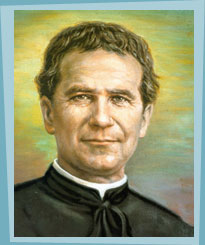
St John (Don) Bosco


Patron saint of op shops? No, actually; but a very cool guy who redefined schooling and particularly nonviolent education.

From here:
Giovanni Bosco was born in 1815 in the farming hamlet of Becchi, now part of the comune which is now named in his honour as Castelnuovo Don Bosco, in north-western Italy), not far from Turin.

When he was little more than four years old, his father died, leaving the support of the sons Antonio (oldest) and Giovanni to their mother, Margherita. Giovanni Bosco's early years were spent on the farm, but he showed ready intelligence and aptitude for study, which was favored by his mother but opposed by Antonio, now head of the family.

Bosco liked to gather other children, entertain them with tricks, jokes, stories, and teach them Catholic catechism (something like Sunday school). Through a series of dreams (in which he saw Mary), he felt to help poor children like himself, by becoming a priest whom they could approach easily. Not like the cold, standoffish clergy he had known.

Bosco frequented the public elementary school in Castelnuovo at the age of 15. He quickly completed the lower grades and graduated with honors in 1835. Then he was accepted into the diocesan seminary at Chier. After six years of study, in 1841, he was ordained a priest in Turin, becoming known as Don Bosco, or “Father Bosco”.

Don Bosco began as the chaplain of a girls’ boarding school founded in Turin by the Marchioness di Barolo, called the Rifugio ("Refuge"). But he had many ministries on the side such as visiting prisoners, teaching catechism and helping out at country parishes. A growing group of boys would come to the Rifugio on Sundays and feast days to play and learn their catechism. They were too old to join the younger children in regular catechism classes in the parishes, which mostly chased them away. This was the beginning of the “Oratory of St. Francis de Sales”. Because of all their disorderly racket, the Marchioness spared her girls the distraction by terminating Bosco’s employment at the Rifugio.

Don Bosco and his Oratory wandered around town for a few years and were turned out of several places in succession. Finally, he was able to rent a shed from a Mr. Pinardi. His mother moved in with him. The Oratory had a home, then, in 1846, in the new Valdocco neighborhood on the north end of town. Next year, he and "Mamma Margaret" began taking in orphans.

Don Bosco's capability to attract numerous boys and adult helpers was connected to his "Preventive System of Education". He believed education to be a "matter of the heart," and said that the boys must not only be loved, but know that they are loved. He also pointed to three components of the Preventive System: reason, religion, and kindness. Music and games also went into the mix.

Tuesday, January 30, 2007

bracks, g20, and the scapegoat mechanism

Was reading this article today and I'm just feeling so frustrated by the whole thing. And this isn't even the Herald Sun, who is doing even less 'balanced' coverage. All the coverage of this has demonised protestors, and now the defense mechanisms protecting the sanctity of police are out in force.

It probably upsets me more because I see the dynamic from the other end too, and what most people don't realise is that exactly the same things are being said by the other 'side'. I'm not going to rat out the detail of the list I read, but most people on it have pretty much scapegoated the police and the government as the only ones who did anything even remotely reprehensible. Couldn't it be that, in actual fact, we as protesters did things wrong as well as the police? Isn't that even possible? Would that tear down the legitimacy of your argument, the argument you've tied your ego to so that it's impossible to separate out the actions of anyone on "your side" and what is or is not 'helpful' or even 'valuable', let alone 'good'?

Then there's just irresponsible and sloppy journalism like this: "The threat of disciplinary proceedings against officers has angered police union leaders, who say protesters pelted their members with bottles and balloons filled with urine."

Rubbish. The police union admitted in the days after the protests there were no urine-filled balloons. This is trotted out at every single freaking protest, and the general public eat it up because it's exactly what they want to hear. It makes protest that much easier to dismiss, and by the time it's proven wrong, it's too late: it's stuck in everyone's minds.

What frustrates me most is the complete inability of the media or politicians to hold or recognise complexity. Could it be that in actual fact many police did act properly, but others didn't, or didn't always? Could it be that in actual fact many protesters, including those who were hit with overhead baton strikes (which are illegal, by the way) were not violent, or even disruptive, though some others were at some times? It doesn't have to be "either all the police acted properly or all the police acted improperly" (and notice the asymmetry of how this is a matter of propriety for police, and criminality for protesters), let alone "either all the protesters were violent or none of the protesters were violent". And the police can't hold the general public to a standard they're not willing to hold themselves to. Particularly in terms of assault and battery.

All this at a time when I was interviewed again today on police tactics by a journalist wanting to write about G20. I know she wanted to hear "yeah, they were awful" but all I had was "it was a real mixed bag..." because it was. Some of them were wonderful to us - we were given icecreams and chocolate bars and had substantial conversations with some. Others were awful - condescending or patronizing, rude or threatening. None of them were completely one or the other. So what do you do with that, as a journalist?

Then there was this pearler from here (Bracks on the complaints from the Human Rights Observer Teams):

"(It) doesn't mean the complaint will be followed through. It may ultimately be thrown out . . . if you look back at the (2000) World Economic Forum I think there was a number of complaints made and I don't know that any of those were substantiated."

Actually, Steve, most of them were substantiated. A massive amount of them. There were even sackings, and disciplinary action. But I suppose you don't remember: it was your first week in office after all. And there's no advantage for you in admitting that police make mistakes too. Even though they do, and that's ok, we can deal with them.

I know the integrity of the Human Rights Observer Teams too. I watched them being set up, have people I know in them, and know how much they cared about their role (a volunteer one, incidentally). I know how they disciplined themselves to be impartial, and to call things only as they saw them. So when they come out with the final report (this is only a preliminary one) you'll know it has the weight of real observations from people of integrity.

But I have no interest in beating up on police (or even Bracks) when in actual fact it's far more complicated than just scapegoating either so-called 'side'. Because that's the whole problem, isn't it? That we cannot (or refuse to) hold complexity, and so we scapegoat, and project our own sin and dirt and rubbish onto others, and for what? For a false peace born of a sense of self-righteousness that never deals with the actual issues or the real causes. Until we can face our own demons, and find them redeemed (not destroyed) we are bound (and I mean bound) to repeat them.

So again I start with me. I try, with everything in me, to refuse to scapegoat. I hold the complexity of both/and instead of either/or. I try - and fail - to stand between both extremes with my arms outstretched saying "no more - for me or anyone else". What else is the cross than that?
Human existence is neither perfectly consistent (what rational and control-needy people usually demand) nor is it incoherent chaos (what cynics, agnostics, and unaware people expect), but instead human life has a cruciform pattern. It is a "coincidence of opposites," a collision of cross-purposes; we are all filled with contradictions needing to be reconciled.

The price that we pay for holding together these opposites is always some form of crucifixion. Jesus himself was crucified between a good thief and a bad thief, hanging between heaven and earth, holding onto both his humanity and divinity, a male body with a feminine soul, expelled as the problem by both religion and state. He rejected none of thesee, but "reconciled all things in himself" (Eph. 2:10) -- Richard Rohr, Everything Belongs.

John Dear in Melbourne!

Finally got all the John Dear promotional material done and sent. As a Myers Briggs iNtuitive and Perceptive, the detail almost killed me, but it looks like I'll live to see him arrive. Which is good because it's almost guaranteed that he will now. Until last week we weren't sure because he had a trial January 25th for a recent action he did against the Iraq war (along with a 15 year old and several grandparents - the inclusiveness of nonviolence). He described it as follows:
I joined eight other New Mexicans -- several grandparents, a few Pax Christi people, and a fifteen-year-old, outstanding people each of them - who entered the Santa Fe Federal Building Sept. 26 bearing a copy of the "Declaration of Peace." Ours was one of 375 actions at various local government offices around the nation. Our destination was the office of Senator Pet Domenic, a prominent warmaker. Would he consider signing our declaration? Might he promise to help bring an end to the war? Reasonable requests, we thought. We also thought our chances unlikely. Still, such a gambit warranted a try, for nonviolence, if it goes deep enough, melts hearts, transforms politics and wins friends.

We got as far as the elevator. Police forbade us from continuing and pulled the plug. So in the elevator we sat, the doors opened to the lobby. The police confided their sympathy for our cause and, while they obstructed us, they refused to arrest us. So we resorted to Plan B. From the elevator floor we read aloud the name of every U.S. soldier killed, and some 10,000 Iraqi civilians. We read for seven hours.

Finally the head of Homeland Security in New Mexico arrived and personally arrested us. Stuffed into our hands were the federal misdemeanor citations, the charge: "failure to conform with signs and direction."

This week we were supposed to stand trial in federal court. But the government has now postponed things until spring. Seems they hope to expand the case against us -- and make sure I cool my heels in jail.

Alas, it's all too likely. But it's also a small price to pay, considering the 1.5 million Iraqis who've been killed over the last 16 years. But more than that, for Christians it's the normal price to pay in the nature of things. Paying up is part and parcel of the Christian's job description. We're supposed to take up the cross of nonviolent resistance to the empire of war, and to accept the consequences.

After all, the person we follow suffered arrest, suffered an abusive stint in jail, brutality and torture, and finally execution. Such is the path for his followers, the way of daring non-violence with all its risks.
Wow. So the trial has been postponed, which means the tour will probably go ahead, assuming the government doesn't pull a Scott Parkin on us. He still reckons he's looking at a one to two month stretch in prison when he gets back.

So go here and download all the promotional material (or the summary of all the events). He'll be well worth your time.

rainbow serpent festival

Ten thousand people wait all year to dance non-stop for three days straight. It's insane.

I was asked to go there (there being a paddock out of Beaufort, a tiny town 40 kms out of Ballarat) and do an NVDA workshop. Alas, people were too busy dancing for the workshop to go ahead, but I got an education and a half, and had a wonderful day talking to some amazing people.

Like Peck (I assume I'm spelling his name correctly) who has lived in the forest in Tassie for three years straight. Yup, just in the forest. He's managed to save a whole bunch of sections of forest from being logged by, amongst other things, finding caves with aboriginal paintings and skeletons in it; trapping and identifying endangered bugs; building a pirate ship with 30 metre masts in the middle of the rainforest; and living up trees on platforms he's built himself.

So this is the sight you're met with when you drive along the road (click on the pictures for a larger version:

And this was the space I was doing the workshop in. It took Holly (the girl managing the space) and three others a whole day to put it up. It's the first time they're made this particular space at Rainbow Serpent; they called it Gaiaganda Eco Space, and it was meant to focus on ecology and such like. They had a biodiesel van and solar power and stuff. Very cool:


So the whole thing has three stages with dance music, and a whole heap of weird and wonderful structures. This one is meant to capture dreams or some such:


And this is one of the stages. Seriously, soooo many people just dancing, dancing, dancing all day:


So this is where I had lunch: in the State Forest nearby. I went off to chill for a while in the peaceful bush away from the doof doof. It was really beautiful:


This is the main stage:


Some pictures from the way home:

And out the side window. Don't worry, I had my eyes on the road:


So an altogether bizarre and wonderful day.

Saturday, January 27, 2007

St Angela Merici

One of the (probably many) saints I hadn't heard of before, Angela seems to have been quite the hardcore chick. I reckon her quote "in reality you have a greater need to serve [the poor] than they have of your service" is a corker. And this one is a fantastic reminder of the nonviolent nature of God who chooses powerlessness over force, "Beware of trying to accomplish anything by force, for God has given every single person free will and desires to constrain none; he merely shows them the way, invites them and counsels them." Beautiful.

From here:
When she was 56, Angela Merici said "No" to the Pope. She was aware that Clement VII was offering her a great honor and a great opportunity to serve when he asked her to take charge of a religious order of nursing sisters. But Angela knew that nursing was not what God had called her to do with her life.

She had just returned from a trip to the Holy Land. On the way there she had fallen ill and become blind. Nevertheless, she insisted on continuing her pilgrimage and toured the holy sites with the devotion of her heart rather than her eyes. On the way back she had recovered her sight. But this must have been a reminder to her not to shut her eyes to the needs she saw around her, not to shut her heart to God's call.

All around her hometown she saw poor girls with no education and no hope. In the fifteenth and sixteenth century that Angela lived in, education for women was for the rich or for nuns. Angela herself had learned everything on her own. Her parents had died when she was ten and she had gone to live with an uncle. She was deeply disturbed when her sister died without receiving the sacraments. A vision reassured her that her sister was safe in God's care -- and also prompted her to dedicate her life to God.

When her uncle died, she returned to her hometown and began to notice how little education the girls had. But who would teach them? Times were much different then. Women weren't allowed to be teachers and unmarried women were not supposed to go out by themselves -- even to serve others. Nuns were the best educated women but they weren't allowed to leave their cloisters. There were no teaching orders of sisters like we have today.

But in the meantime, these girls grew up without education in religion or anything at all.

These girls weren't being helped by the old ways, so Angela invented a new way. She brought together a group of unmarried women, fellow Franciscan tertiaries and other friends, who went out into the streets to gather up the girls they saw and teach them. These women had little money and no power, but were bound together by their dedication to education and commitment to Christ. Living in their own homes, they met for prayer and classes where Angela reminded them, "Reflect that in reality you have a greater need to serve [the poor] than they have of your service." They were so successful in their service that Angela was asked to bring her innovative approach to education to other cities, and impressed many people, including the pope.

Though she turned him down, perhaps the pope's request gave her the inspiration or the push to make her little group more formal. Although it was never a religious order in her lifetime, Angela's Company of Saint Ursula, or the Ursulines, was the first group of women religious to work outside the cloister and the first teaching order of women.

It took many years of frustration before Angela's radical ideas of education for all and unmarried women in service were accepted. They are commonplace to us now because people like Angela wanted to help others no matter what the cost. Angela reminds us of her approach to change: "Beware of trying to accomplish anything by force, for God has given every single person free will and desires to constrain none; he merely shows them the way, invites them and counsels them."

Saint Angela Merici reassured her Sisters who were afraid to lose her in death: "I shall continue to be more alive than I was in this life, and I shall see you better and shall love more the good deeds which I shall see you doing continually, and I shall be able to help you more." She died in 1540, at about seventy years old.

Friday, January 26, 2007

St Timothy and St Titus

This feast of St Timothy and St Titus falls on Australia Day, or as it has more appropriately been dubbed, Invasion Day. These guys were the recipients of the Pastoral letters of Paul (though the authenticity of Paul's authorship is contested). It would be worth reflecting today on the intersection of pastoral care and the Anglo foundations of today's Australia.

St Timothy from here:
Partner, assistant and close personal friend of Saint Paul. Missionary. Head of the Church in Ephesus. Recipient of 2 canonical letters from Paul.

Born at Lystra, Lycaenia, Timothy was the son of a Greek father and Eunice, a converted Jewess. He replaced Barnabus when Paul preached at Lystra, and became Paul's close friend and confidant. Paul allowed him to be circumcised to placate the Jews, since he was the son of a Jewess, and he then accompanied Paul on his second missionary journey. When Paul was forced to flee Berea because of the enmity of the Jews there, Timothy remained, but after a time was sent to Thessalonica to report on the condition of the Christians there and to encourage them under persecution, a report that led to Paul's first letter to the Thessalonians when he joined Timothy at Corinth. Timothy and Erastus were sent to Macedonia in 58, went to Corinth to remind the Corinthians of Paul's teaching, and then accompanied Paul into Macedonia and Achaia. Timothy was probably with Paul when the Apostle was imprisoned at Caesarea and then Rome, and was himself imprisoned but then freed. According to tradition, he went to Ephesus, became its first bishop, and was stoned to death there when he opposed the pagan festival of Katagogian in honor of Diana. Paul wrote two letters to Timothy, one written about 65 from Macedonia and the second from Rome while he was in prison awaiting execution.
And St Titus from here:
A disciple and companion of St. Paul to whom the great saint addressed one of his letters. Paul referred to Titus as "my true child in our common faith". Not mentioned in the Acts of the Apostles, he was noted in Galatians where Paul writes of journeying to Jerusalem with Barnabas, accompanied by Titus. He was then dispatched to Corinth, Greece, where he successfully reconciled the Christian community there with Paul, its founder. Titus was later left on the island of Crete to help organize the Church, although he soon went to Dalmatia, Croatia. According to Eusebius of Caesarea in the Ecclesiastical Histor y, he served as the first bishop of Crete. He was buried in Cortyna (Gortyna), Crete; his head was later translated to Venice during the invasion of Crete by the Saracens in 832 and was enshrined in St. Mark’s, Venice, Italy.

Thursday, January 25, 2007

The feast of the Conversion of St Paul

It was just last Sunday that I was talking with Anthony about how important this story is for us today, right now, in the world in which we find ourselves. So here it is, the story of the conversion of St Paul (prefaced with one of the stories of his pre-conversion life):
Acts 7:54When they heard this, they were furious and gnashed their teeth at him. 55But Stephen, full of the Holy Spirit, looked up to heaven and saw the glory of God, and Jesus standing at the right hand of God. 56"Look," he said, "I see heaven open and the Son of Man standing at the right hand of God."

57At this they covered their ears and, yelling at the top of their voices, they all rushed at him, 58dragged him out of the city and began to stone him. Meanwhile, the witnesses laid their clothes at the feet of a young man named Saul.

8:1And Saul was there, giving approval to his death.

Acts 9:1Meanwhile, Saul was still breathing out murderous threats against the Lord's disciples. He went to the high priest 2and asked him for letters to the synagogues in Damascus, so that if he found any there who belonged to the Way, whether men or women, he might take them as prisoners to Jerusalem. 3As he neared Damascus on his journey, suddenly a light from heaven flashed around him. 4He fell to the ground and heard a voice say to him, "Saul, Saul, why do you persecute me?"

5"Who are you, Lord?" Saul asked.

"I am Jesus, whom you are persecuting," he replied. 6"Now get up and go into the city, and you will be told what you must do."

7The men traveling with Saul stood there speechless; they heard the sound but did not see anyone. 8Saul got up from the ground, but when he opened his eyes he could see nothing. So they led him by the hand into Damascus. 9For three days he was blind, and did not eat or drink anything.

10In Damascus there was a disciple named Ananias. The Lord called to him in a vision, "Ananias!"
"Yes, Lord," he answered.

11The Lord told him, "Go to the house of Judas on Straight Street and ask for a man from Tarsus named Saul, for he is praying. 12In a vision he has seen a man named Ananias come and place his hands on him to restore his sight."

13"Lord," Ananias answered, "I have heard many reports about this man and all the harm he has done to your saints in Jerusalem. 14And he has come here with authority from the chief priests to arrest all who call on your name."

15But the Lord said to Ananias, "Go! This man is my chosen instrument to carry my name before the Gentiles and their kings and before the people of Israel. 16I will show him how much he must suffer for my name."

17Then Ananias went to the house and entered it. Placing his hands on Saul, he said, "Brother Saul, the Lord—Jesus, who appeared to you on the road as you were coming here—has sent me so that you may see again and be filled with the Holy Spirit." 18Immediately, something like scales fell from Saul's eyes, and he could see again. He got up and was baptized, 19and after taking some food, he regained his strength.
Then, in Paul's own words:
9"I too was convinced that I ought to do all that was possible to oppose the name of Jesus of Nazareth. 10And that is just what I did in Jerusalem. On the authority of the chief priests I put many of the saints in prison, and when they were put to death, I cast my vote against them. 11Many a time I went from one synagogue to another to have them punished, and I tried to force them to blaspheme. In my obsession against them, I even went to foreign cities to persecute them.

12"On one of these journeys I was going to Damascus with the authority and commission of the chief priests. 13About noon, O king, as I was on the road, I saw a light from heaven, brighter than the sun, blazing around me and my companions. 14We all fell to the ground, and I heard a voice saying to me in Aramaic,[a] 'Saul, Saul, why do you persecute me? It is hard for you to kick against the goads.'

15"Then I asked, 'Who are you, Lord?'

" 'I am Jesus, whom you are persecuting,' the Lord replied. 16'Now get up and stand on your feet. I have appeared to you to appoint you as a servant and as a witness of what you have seen of me and what I will show you. 17I will rescue you from your own people and from the Gentiles. I am sending you to them 18to open their eyes and turn them from darkness to light, and from the power of Satan to God, so that they may receive forgiveness of sins and a place among those who are sanctified by faith in me.'

19"So then, King Agrippa, I was not disobedient to the vision from heaven. 20First to those in Damascus, then to those in Jerusalem and in all Judea, and to the Gentiles also, I preached that they should repent and turn to God and prove their repentance by their deeds. 21That is why the Jews seized me in the temple courts and tried to kill me.
So there we have it: a murderer and terrorist mastermind turns into the man who writes most of the New Testament.

I was talking with Anthony about Rene Girard's ideas about sacred violence, what justifies it, and how Jesus debunks it. Every day we hear about the "terrorist threat" and how we must kill people in order to save ourselves, to save our world. Only recently we've seen the death of Saddam Hussein at the end of a hangman's noose. We justify killing them on the grounds that they are lost causes: that they are irredeemably evil, that they will never change.

And then we read the story of Saul/Paul. And we have to reconsider.

Because God chose a terrorist to take the message of love and peace and salvation to the world. This is the man who wrote in 1 Corinthians 1:19-25, "Where is the wise man? Where is the scholar? Where is the philosopher of this age? Has not God made foolish the wisdom of the world? For since in the wisdom of God the world through its wisdom did not know him, God was pleased through the foolishness of what was preached to save those who believe. Jews demand miraculous signs and Greeks look for wisdom, but we preach Christ crucified: a stumbling block to Jews and foolishness to Gentiles, but to those whom God has called, both Jews and Greeks, Christ the power of God and the wisdom of God. For the foolishness of God is wiser than man's wisdom, and the weakness of God is stronger than man's strength." In other words, all those things you think are smart, that you think make sense in the world's estimation (power, strength, violence, force, etc) is foolishness in real terms. And Paul gets this. He converts from trusting in the power of strength and force and violence and 'smartness' to powerlessness, and foolishness.

This is a celebration of God redeeming the seemingly irredeemable. Of trusting in the foolishness of powerlessness over apparent strength and force and 'intelligence'. What now can justify our violence, even towards those we see as "deserving"?

Wednesday, January 24, 2007

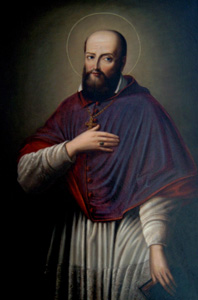
St Francis de Sales

I first came across St Francis de Sales in a course at Whitley that looked at a whole bunch of devotional writings that have stood the test of time. Actually that’s not entirely true: I had clearly come across his legacy every time I drove past Salesian College; though I would never have known it. I always assumed Salesians were the people from a tiny, probably now-defunct Balkans country. Anyway, among the devotional texts from my course was Francis de Sales’ ‘Introduction to the Devout Life’. It’s amazing, and I’d recommend you read it if you get the chance.

So here’s to St Francis de Sales.

From Wikipedia:
Francis de Sales was born into a noble family. He was the first of twelve children, and as such enjoyed an education in La Roche and Annecy; His father only wanting him to attend the best schools. In 1578 at the age of 12 he went to the Collège de Clermont in Paris. A year later Francis was engulfed in a personal crisis when after attending a theological discussion about predestination became convinced that he was damned to hell. In December 1586 his despair was so great that he was physically ill and even bed ridden for a time. In January 1587 he visited the Church Saint-Etienne des Gres with great difficulty. There his crisis ended, and he decided to dedicate his life to God. Francis came to the conclusion that whatever God had in store for him was good, because God is love. This faithful devotion to the God of love not only expelled his doubts, but also influenced the rest of his life and his teachings.

In 1588 Francis transferred from Paris to the University of Padua where he studied both law and Theology. At the University he made up his mind about becoming a priest. In 1592 he ended his studies with the promotion to doctor certified in both law and theology. Then he made the pilgrimage to Loreto before going home. At home his father had already secured a variety of positions for his son, one of which was a position on the Senate of Chambéry. It was difficult for Francis' father to accept that his son had already chosen another career.

After studying the humanities, rhetoric, theology, and law at La Roche, Annecy, Paris, and Padua, he famously refused to marry the wealthy heiress his father had chosen as his bride, preferring a clerical career. The intervention of Claude de Granier, then bishop of Geneva, won him ordination and appointment as provost of the cathedral chapter of Geneva in 1593.

Since the Reformation, the seat of the bishops of Geneva had been located at Annecy in Savoy, due to Calvinist control of Geneva itself. Francis, in his capacity as provost, engaged in enthusiastic campaigns of evangelism among the Protestants of Savoy, winning many returns to the Old Faith. He also traveled to Rome and Paris, where he forged alliances with Pope Clement VIII and the French King Henry IV.

In 1602, Bishop Granier died, and Francis was consecrated bishop of Geneva himself. During his years as bishop, he garnished a reputation as a spellbinding preacher and something of an ascetic; in particular, he was known as a friend of the poor, a man of almost supernatural affability and understanding. These last qualities come through wonderfully in his famous books. He died on 28 December 1622 in Lyon, while he travelled in the entourage of Charles Emmanuel I, Duke of Savoy.

Francis of Sales was beatified in 1661 by Pope Alexander VII, who then canonized him in 1665. His feast day is January 24. In 1877, Pope Pius IX declared him a doctor of the Universal Church.

In 1923 Pope Pius XI proclaimed him a patron of writers and journalists, because of the books he wrote, the most famous of which was Introduction à la vie dévote ("Introduction to the Devout Life"). He also left the mystical Traité de l' Amour de Dieu ("Treatise on the Love of God") and many highly valued epistles of spiritual direction. He was a notably clear and gracious stylist in French, Italian and Latin.

Tuesday, January 23, 2007

The Holy Transfiguration Monastery

PLEASE NOTE: If you're reading this because you want to contact the Holy Transfiguration Monastery, please don't ask me for their contact details. Thanks.

A few inspirallers have been talking about intentional community for a while, and as a result we've decided to do some serious research into what that might look like. So this Saturday we're heading down to Geelong to hang out with some of the members of the Holy Transfiguration community. One of only two Baptist monasteries in the world, Breakwater are a rare and beautiful expression of Christian community. We're wanting to learn about how their journey of integrity towards deeper community, but also to forge links between their group and ours. And I wanted to draw attention to this amazing group right here, where people who would ordinarily not come across a group such as this would have the chance to be as affected by them as I am being.

From here:
The Holy Transfiguration Monastery
Breakwater, Victoria, Australia

by Paul R. Dekar

Holy Transfiguration Monastery is a center of renewal in Breakwater, a working-class neighborhood of Geelong, a city of 200,000 on the west of Port Phillip Bay, in the state of Victoria in Australia. A compelling adaptation of historic Christian monastic traditions to contemporary life, the community is unique in that it continues the life and witness of a 135-year old Baptist congregation while drawing on classic sources of Christian monasticism.

Holy Transfiguration Monastery began in the early 1970s, a period when many Christians around the world re-appraised economic, political, and religious structures. Graeme Littleton and Steven Shipman met during a monastic formation program at The Community of the Glorious Ascension, an Anglican monastery in England. They came to share the vision out of which Holy Transfiguration Community emerged. Littleton and Shipman studied the Rule of Benedict, Orthodox sources, and a number of models of communal life, including Ephrata, an Anabaptist experiment that began in the eighteenth century in Lancaster County, Pennsylvania.

As the community grew, members developed a Resolve, the practices by which they live as follows:

* Being perfectly assured of your salvation, with your whole life proclaim your gratitude.
* Reject nothing, consecrate everything.
* Be the good of love, for God, for neighbor, for all creation.
* Judge no one, not even yourself.
* Love beauty.
* Maintain inner silence in all things.
* Show hospitality, err only on the side of generosity.
* Speak truth to power, especially power without love.
* Let your only experience of evil be in suffering, not its creation.
* For us there is only the trying, the rest is none of our business.

The community has over thirty members who live in the Cloister or nearby. Members observe traditional monastic commitments to hospitality, obedience, stability, and a balanced life of prayer and work. Celibacy is not an obligation. While several members have chosen a celibate life, married couples also live in the Cloister. Families live in houses, while the celibate sisters and brothers live in single-sex households. Members support themselves through ordinary work. In accord with Acts 2:45 and Acts 4:34, twelve live under the common purse, while members of the Greater Community tithe.

Holy Transfiguration Monastery members observe times of silence, stillness, and solitude. The daily rhythm of prayer focuses on some aspect of the life of Jesus: Mondays, incarnation; Tuesdays, baptism; Wednesdays, transfiguration; Thursdays, the last supper. On Friday, members observe Taizé-like prayers around the cross. On Saturday evening a Sabbath service announces the Resurrection. Sunday is a literal day of rest.

While on the grounds members generally wear habits or, at the Eucharist, white baptismal albs. They extend an invitation to any baptized person to do the same. A communal meal shared by many visitors follows the Eucharist. The liturgical and prayer forms of the community are intentionally contemplative and reflective. Singing plays a great part in all the liturgies. The community follows the Christian year and has developed significant liturgies unique to Advent, Epiphany, Lent, Ascension, Pentecost, Transfiguration, Holy Cross, and Christ Pantokrator, with the One who holds all opposites together in creative tension as the focus of reflection, Easter is a season for renewal of one's baptismal vows.

Holy Transfiguration Monastery members observe times of silence, stillness, and solitude.

Members have written prayers and liturgies that are ancient and contemporary, meditative, and dynamic, reflective and socially attuned. Holy Transfiguration Monastery has attracted to its membership several master crafts persons and artists. The icons, vestments, architecture, stained glass, and other artistic features embody monastic values of simplicity and holiness. Backed by a well-articulated theology, members offer their gifts to God in gratitude.

Members seek to respect the beauty of creation. With three buildings set aside for worship specifically, nearly a dozen houses, gardens, and a guesthouse, the property encompasses two acres. Once a garbage heap, the Cloister is now a protected bird sanctuary. Members have also been actors in local campaigns to maintain ecological balance in Breakwater through efforts to preserve the habitat along the Barwon River nearby.

The Breakwater community attracts members from many denominations, including the Anglican, Baptist, Catholic, and Uniting churches of Australia. Among its advisors are representatives of other monasteries in Australia, including the Benedictine Abbey of St. Mark in Camperdown, and the Cistercian Tarrawarra Abbey in the Yarra River valley.

Holy Transfiguration has maintained a Skete in Melbourne, where the monastery strongly influenced a number of congregations. Communities in Perth in Western Australia, in the United Kingdom, and in the United States are exploring ways to twin or otherwise identify with Holy Transfiguration.
And make that Brunswick too.

Monday, January 22, 2007

St Vincent Pallotti

From here:
Born in Rome in 1795, St. Vincent became a priest and dedicated himself completely to God and cared for souls. He dreamed of gaining for Christ all non-Catholics, especially Muslims. To this end he inaugurated a revolutionary program which involved both the laity and the clergy. But St. Vincent was also well aware of the many deprivations in the natural sphere that hindered the spread of the Faith. He thus obtained and spent huge sums for the poor and underprivileged. He founded guilds for workers, agriculture schools, loan associations, orphanages and homes for girls - all of which made him the pioneer and precursor of Catholic Action. His great legacy was the congregation which he founded for urban mission work, known as the "Society for Catholic Action". This indefatigable laborer for Christ in 1850 from a severe cold which he most likely caught on a cold rainy night after giving his cloak to a beggar who had none.
I came across Vincent at my first trip to Pallotti in Millgrove (ordination retreat): a retreat centre in the hills near Healesville. A truly beautiful place, not merely because of the setting (which is truly stunning) but because of the community that serve there. It was there I discovered the work that has taken place among Australian indigenous people in the tradition of Vincent Pallotti. Turns out the Pallottines have done more work than any other group, and much earlier, to preserve and honour our indigenous heritage.

Then early last year, after meeting Brendan McKeague (I can't believe that was only last year!), I discovered the Pallottine community in Kew, near Studley Park. Amazing people, doing wonderful, humble work. Their love and hospitality are so good, they've agreed to host Father John Dear on his visit here, at my request. So Vincent Pallotti has had an effect on me, and he goes on having an effect on others too, whether they recognise it as him or not. On this day where we celebrate him and his faithfulness to God, I can truly give thanks in a very personal way.

Saturday, January 20, 2007

St Fabian and St Sebastian

St Fabian (from here): Fabian came to Rome as an unknown layperson after Pope Anteros died in 236. Seeing all the important people gathered to make this momentous decision must have been overwhelming. Which one would be the new pope? Someone known for power? Someone known for eloquence? Someone known for courage?

Suddenly during the discussion, a dove descended from the ceiling. But it didn't settle on "someone known" for anything at all. The dove, according to Eusebius, "settled on [Fabian's] head as clear imitation of the descent of the Holy Spirit in the form of a dove upon the Savior." There must have been something of the Holy Spirit working because everyone suddenly proclaimed Fabian as "worthy" to be pope and this stranger was elected.

The dove signifies peace, and this dove was prophetic. Starting close to Fabian's election, the suffering and persecuted Church began a time of peace. The emperor, Philip, was friendly to Christians and not only was the persecution stopped but Christians experienced acceptance.

But, in a timeless story, the people who had always been in power were not happy to see the newcomers growing and thriving. The new emperor, Decius, ordered all Christians to deny Christ by offering incense to idols or through some other pagan ritual.

In the few years of peace, the Church had grown soft. Many didn't have the courage to stand up to martyrdom. But Fabian, singled out by symbol of peace, stood as a courageous example. He died a martyr in 250 and is buried in the Cemetery of Calixtus that he helped rebuild and beautify. A stone slab with his name can still be found there.

St Sebastian (from here): According to his legend, Sebastian was born at Narbonne, Gaul. He became a soldier in the Roman army at Rome in about 283, and encouraged Marcellian and Marcus, under sentence of death, to remain firm in their faith. Sebastian made numerous converts: among them were the master of the rolls, Nicostratus, who was in charge of prisoners and his wife, Zoe, a deaf mute whom he cured; the jailer Claudius; Chromatius, Prefect of Rome, whom he cured of gout; and Chromatius' son, Tiburtius. Chromatius set the prisoners free, freed his slaves, and resigned as prefect.

Sebastian was named captain in the praetorian guards by Emperor Diocletian, as did Emperor Maximian when Diocletian went to the East. Neither knew that Sebastian was a Christian. When it was discovered during Maximian's persecution of the Christians that Sebastian was indeed a Christian, he was ordered executed. He was shot with arrows and left for dead, but when the widow of St. Castulus went to recover his body, she found he was still alive and nursed him back to health. Soon after, Sebastian intercepted the Emperor, denounced him for his cruelty to Christians, and was beaten to death on the Emperor's orders.

Saint Sebastian was venerated at Milan as early as the time of St. Ambrose and was buried on the Appian Way. He is patron of archers, athletes, and soldiers, and is appealed to for protection against plagues.

tonight, at coles express

So we drop into the petrol station at Glenlyon Road on our way home from Carolyn and Karl's place to pick up some gas (the LPG kind, not gasoline). As I go into the shop to pay for it, I vaguely hear some familiar lilting strains...I dismiss it, but then I hear it again and suddenly I'm gripped. I do a double take. Could it possibly be? It IS! OH MY GOODNESS!

My song of 2006, and perhaps the most obscure song ever from an unknown band from the early 90's, is playing over the loudspeaker.

Give it Up, a song by Hothouse Flowers, was released as a single in 1990 and - like an explorer who happens upon a tribe of cannibals - hasn't been heard from since. And yet here it is on the radio, not three weeks into 2007, after being featured as song of the year on my 2006 compilation.

At this point, I realise the clerk must have seen my face and with delight written all over it I ask, "Is this a cd?" His bewilderment written all over his, he replies, "Uh...no."

"Get out!" I say. "This is the radio? Are you serious?"

"Yes," he says. At this point, he's not sure whether to laugh at this strange man or press the panic button under the desk.

"What station is it? Do you know?" I ask excitedly.

"No...sorry." At this point, he is clearly weirded out by my total euphoria and, my transactions finished, begins backing away from the counter with one eyebrow raised dubiously. I wander around the store dazed for a minute or two listening to the song before bolting for the car to check which station it is. I drive home elated.

(by the way, in case you were curious...it was TripleM.)

Wednesday, January 17, 2007

St Antony

Founder of Christian monasticism. The chief source of information on St. Antony is a Greek Life attributed to St. Athanasius, to be found in any edition of his works. Anthony was born at Coma, near Heracleopolis Magna in Fayum, about the middle of the third century. He was the son of well-to-do parents, and on their death, in his twentieth year, he inherited their possessions. He had a desire to imitate the life of the Apostles and the early Christians, and one day, on hearing in the church the Gospel words, "If thou wilt be perfect, go and sell all thou hast", he received them as spoken to himself, disposed of all his property and goods, and devoted himself exclusively to religious exercises. Long before this it had been usual for Christians to practice asceticism, abstain from marriage and exercising themselves in self-denial, fasting, prayer, and works of piety; but this they had done in the midst of their families, and without leaving house or home. Later on, in Egypt. such ascetics lived in huts, in the outskirts of the towns and villages, and this was the common practice about 270, when Anthony withdrew from the world.

He began his career by practising the ascetical life in this fashion without leaving his native place. He used to visit the various ascetics, study their lives, and try to learn from each of them the virtue in which he seemed to excel. Then he took up his abode in one of the tombs, near his native village, and there it was that the Life records those strange conflicts with demons in the shape of wild beasts, who inflicted blows upon him, and sometimes left him nearly dead. After fifteen years of this life, at the age of thirty-five, Anthony determined to withdraw from the habitations of men and retire in absolute solitude. He crossed the Nile, and on a mountain near the east bank, then called Pispir, now Der el Memum, he found an old fort into which he shut himself, and lived there for twenty years without seeing the face of man, food being thrown to him over the wall. He was at times visited by pilgrims, whom he refused to see; but gradually a number of would-be disciples established themselves in caves and in huts around the mountain, Thus a colony of ascetics was formed, who begged Anthony to come forth and be their guide in the spiritual life. At length, about the year 305, he yielded to their importunities an emerged from his retreat, and, to the surprise of all, he appeared to be as when he had gone in, not emaciated, but vigorous in body and mind. For five or six years he devoted himself to the instruction and organization of the great body of monks that had grown up around him; but then he once again withdrew into the inner desert that lay between the Nile and the Red Sea, near the shore of which he fixed his abode on a mountain where still stands the monastery that bears his name, Der Mar Antonios.

Saturday, January 13, 2007

St Hilary

From here:
Hilary went looking for the giftgiver. He was told many things about the divine -- many that we still hear today: that there were many Gods, that God didn't exist but all creation was the result of random acts of nature, that God existed but didn't really care for his creation, that God was in creatures or images. One look in his own soul told him these images of the divine were wrong. God had to be one because no creation could be as great as God. God had to be concerned with God's creation -- otherwise why create it?

At that point, Hilary tells us, he "chanced upon" the Hebrew and Christian Scriptures. When he read the verse where God tells Moses "I AM WHO I AM" (Exodus 3:14), Hilary said, "I was frankly amazed at such a clear definition of God, which expressed the incomprehensible knowledge of the divine nature in words most suited to human intelligence."
When Hilary refused to support their condemnation of Saint Athanasius he was exiled from Poitiers to the East in 356. The Arians couldn't have had a worse plan -- for themselves.

Hilary really had known very little of the whole Arian controversy before he was banished. Perhaps he supported Athanasius simply because he didn't like their methods. But being exiled from his home and his duties gave him plenty of time to study and write. He learned everything he could about what the Arians said and what the orthodox Christians answered and then he began to write. "Although in exile we shall speak through these books, and the word of God, which cannot be bound, shall move about in freedom." The writings of his that still exist include On the Trinity, a commentary on the Gospel of Matthew, and a commentary on the Psalms. He tells us about the Trinity, "For one to attempt to speak of God in terms more precise than he himself has used: -- to undertake such a thing is to embark upon the boundless, to dare the incomprehensible. He fixed the names of His nature: Father, Son, and Holy Spirit. Whatever is sought over and above this is beyond the meaning of words, beyond the limits of perception, beyond the embrace of understanding."

Thursday, January 11, 2007

addiction defined

addiction (ə-dĭk'shən) n. 1.Doing the same thing over and over and expecting different results.

Wednesday, January 10, 2007

he's my friend!

Congratulations to Jarrod, who has been in Tassie the last few days at the Quaker Yearly Meeting, receiving the Donald Groom Peace Fellowship. It's a Quaker award granted to further work in the area of peace and nonviolence.

There's been lots of glowing things said about him in many other places, such as here and here, so I'll just say:

"He's my friend!"

humus

I am done with great things
And big things, great institutions
And big success, and I am for those
Tiny invisible molecular moral
Forces that work from individual
To individual, creeping through
The crannies of the world like
So many rootlets, or like the
Capillary oozing of water
Yet which, if you give them time, will
Rend the hardest monuments
Of man's pride.
--William James

Sunday, January 07, 2007

The Feast of the Baptism of the Lord

John 1:1-7,19-20,29-34

1In the beginning was the Word, and the Word was with God, and the Word was God. 2He was in the beginning with God. 3All things came into being through him, and without him not one thing came into being. What has come into being 4in him was life, and the life was the light of all people. 5The light shines in the darkness, and the darkness did not overcome it.

6 There was a man sent from God, whose name was John. 7He came as a witness to testify to the light, so that all might believe through him.

19 This is the testimony given by John when the Jews sent priests and Levites from Jerusalem to ask him, ‘Who are you?’ 20He confessed and did not deny it, but confessed, ‘I am not the Messiah.’

29 The next day he saw Jesus coming towards him and declared, ‘Here is the Lamb of God who takes away the sin of the world! 30This is he of whom I said, “After me comes a man who ranks ahead of me because he was before me.” 31I myself did not know him; but I came baptizing with water for this reason, that he might be revealed to Israel.’ 32And John testified, ‘I saw the Spirit descending from heaven like a dove, and it remained on him. 33I myself did not know him, but the one who sent me to baptize with water said to me, “He on whom you see the Spirit descend and remain is the one who baptizes with the Holy Spirit.” 34And I myself have seen and have testified that this is the Son of God.’

Friday, January 05, 2007

happy epiphany!

This year I'm going to do something I never wanted enough to do before, but now realise I need: invest myself in the church year. My tradition rejected anything like this that smacked of "Catholicism" - Catholics worshipped Mary, so we wanted nothing to do with that kind of heresy. We were good Protestants after all. Since then I've discovered that we kind of threw many babies out with the bathwater with the whole Reformation thing, and maybe there are some we can recover. But I haven't been ready for this one until now.

Basically the church year lives out the whole story of Jesus, and along the way gets to celebrate many of the saints who, throughout history, have done amazing things that are worth celebrating not only as part of our heritage and story, but as lessons to learn. We Protestants have kept Christmas and Easter but they just kind of float there, isolated, like little buoys in a sea of contrary lives.

To this end, I have set up a little sacred space in my office, where I will try to, daily, enter into the holiness of that day and the presence of God in it:


I'd resisted sacred spaces because I didn't want a separation between the "sacred" and what we often call the "secular" - there is no difference (more on that soon). So really this is a space free of clutter, in which to put things that focus my attention on things that are worth my focus; literally a place in which to be different, in a way that habit undoes in me in other places. Largely this decision to follow the church year is a realisation that I need to invest myself deeply in two things: the first is a story, namely the Christian story; and secondly in the practices that accompany that. And what better way to invest myself in that story than to take up some of the practices that have mediated God to humans throughout history.

And so I begin, appropriately, with the solemnity of the Epiphany (tomorrow). The "revelation"; the "unveiling". To that end, I share Richard Rohr's reflections on today with you. I'm not going to argue Catholic vs Protestant theology here: just enter into it, let it sink deeply into you:
"Every time Catholics celebrate Eucharist, we take something of this earth, of this world, bread and wine, and we say - daringly, unbelievably - it's God. I don't know any other religion that ever does that. Most of the world's religions - Hinduism, Buddhism and many forms of Protestantism - are always trying to get you up into transcendental holy thinking: ideas, explanations, and principles, visions. The Catholic worldview is always saying, "Get us into history, get into the flesh, get into the bread and wine, get into the material." Get into this world and the world will still be the mediation point of the spiritual.

That's our greatest strength. The fancy word for that is incarnational Christianity. The most popular feast is not Easter. You'd have no doubt about it if you have ever been to Europe, or any countries where Catholicism held the strongest sway. The big feast is Christmas, the feast of the Incarnation, the proclamation that God became flesh in a little baby. Easter's redemption is just the logical conclusion." (originally from "Why Be Catholic?", quoted in Richard Rohr "Radical Grace: Daily Meditations".)

Tuesday, January 02, 2007

the me yangs

Took a drive to the You Yangs last week. Climbed Flinder's Peak and hung out there for a while. The following are some pictures I took on my phone (hence the terrible quality):

A koala. A New Zealand guy drew my attention to it. He said excitedly, "Wow, I've never seen one in the wild before!" (actually it was more like "wiw, I've niver sin one un the wild biffore!" but I'm not one to stereotype). Not wanting to burst his bubble (or the bubble of any other foreigner who thinks Australia is overrun with kangaroos, koalas and other native furry creatures), I swallowed my own excitement and nonchalantly drawled back, "Well, now you have eh?"


A rock. Trust me, it was much better in person.


The view from Flinder's Peak. It's surprisingly high. You can see Geelong in one direction and Melbourne in the other, and right across the bay.


The view from the other side of Flinder's Peak. Turns out the name You Yangs comes from the Aboriginal words 'Wurdi Youang' or 'Ude Youang' meaning 'big mountain in the middle of a plain'. It's a name entirely devoid of irony.

The view from the spot I eventually settled on.

Anyway, the upshot is I have to do this stuff more often. Turns out being by myself suits this introvert.