Thursday, May 11, 2006

against substitutional atonement

For many years, probably as long as I can remember, I've been skeptical of the traditional "gospel" message of substitutional atonement. I've always had this uneasiness about it, that for many years I couldn't put my finger on. Roughly speaking, substitutional atonement is the idea that Jesus died as a substitutional sacrifice for our sins. It's a little more specific than that, actually. It's actually based on the medieval feudal system, where when Lords (yes, the reason we still call God "Lord" is a hangover from these days) were offended by an underling, they would require some kind of equal and opposite reaction to effectively make up for, or cover over, their offended honour. This was extrapolated onto God (God requires death as a substitute for his offended honour), the Bible was read through this system, no-one was game to update it, and voila! you have yourself some authentic 21st century theology.

Vaguely, I wondered why God couldn't just forgive without requiring death. Plus what kind of God is prepared to kill his own son before other people, let alone at all? It just sounds monstrous. It's a bloodthirsty God, not the loving God I was taught about.

I can remember the first time I was interviewed for candidature for ordination with the Baptist Union, and going through the third degree in the theology interview. It was around this time that I had decided that it was no use my pretending anymore that I did agree with substitutional atonement (fairly brave timing, if I do say so myself, particularly with no viable alternative), and so the conversation went roughly like this (names withheld to protect the innocent, although I remember it clear as day):

Interviewer: So why did Jesus have to die for our sins?
Simon: I don't know.
Interviewer: You don't know? Do you have any idea?
Simon: Not really...no.

Later, I realised that I did have more of an idea but the problem was that I didn't like where it was heading, and so I wanted to articulate that. I was given an opportunity to do so in the larger, group interview situation. I explained that as a philosopher, I usually thought two assumptions ahead, and that I had done so on this occasion.

Me: I know that Jesus had to die to pay for our sins. He had to do that because sin requires death, and God being a just God had to mete out the just punishment for sin. What I don't know is why God requires death for sin. So, when I said I didn't know why Jesus had to die, what I meant was that I don't know why God requires death.
High ranking BUV person: Me neither, Simon. Me neither.

Maybe it's an exaggeration, but I reckon his admission probably saved my faith. You could say my faith was reasonably strong at that stage (given where I was when this took place) and could have withstood the crack that had appeared in its foundation, but I was done with pretending. The crack was widening by the day, and would have proved fatal, and his admission gave me a reason to start building a new foundation instead of patching the old. It was probably the first inkling I had that heads wiser than mine were as skeptical as I was, and that I had good reason for my skepticism.

There was a conversation on the VBMN (Victorian Baptist Ministers' Network) a while back about this very issue, and one of the respondents raised the issue that substitutional atonement means that God asks more of us than of Godself. That is, God asks us to forgive without condition, yet God is clearly unwilling to do the same, instead making forgiveness conditional upon some propitiation and sacrifice. Certainly it could be said that God is 'entitled' to do so, but it seems to not only imply a double standard in God, but go against the very concept of grace that Jesus demonstrates.

Last night I was reading an article in From Violence to Wholeness that fairly well articulated my intuitive abhorrence of substitutional atonement. It's a passage about Jesus and nonviolence (obviously):
The third foundation of Jesus' nonviolence is located in his understanding of God and in his approach to worship. The kind of radical love Jesus knows in God creates an awareness that human life is not about appeasing a vengeful God, but about responding in love. This is a spirituality purified of violence at its very roots. God, for Jesus and for those who follow the Christian way, is assertively and polemically against death in all its forms and is for life in all its fullness. The enemies of Jesus, such as the Herodians and Pharisees, may have had room in their theology for a God who would require someone to suffer and die - but this is not the God of Jesus. (From The Faithful Nonviolence of Jesus, by Nancy Schreck, words in bold are my emphasis)
So, she is saying that it would be against God's nature, the very core of who God is, to require someone to die (which is the thesis of substitutional atonement). She goes on to talk about an alternative reason for Jesus' death, one that flies in the face of talk of Jesus "coming to Earth for the purpose of dying for our sins", indeed, one that leaves room for God to oppose it utterly:
Jesus' life journey would end in Jerusalem, and the question arises: If Jesus knew of the escalation of violence against him, why did he go there? It was not to fulfill some mandate of death, but to be faithful to the divine mandate he struggled to fulfill all his life, that of overcoming those who promoted death, who cultivated its structures, whose allegiance to it is seen in their willingness to kill when it is to their advantage to do so.
The point here is that Jesus consistently and repeatedly shunned death, by refusing any act which reduced or demeaned or violated another human being, and more than that, chose to act in life-giving ways toward everyone he encountered, making him the embodiment of pure love. He did so even in the face of those who violated him, demeaned and reduced him, acts that we commit every day against other people, who Jesus aligns with himself, calling them "the least of these".

This seems not only plausible to me in an intellectual sense, but has the ring of truth about it in a soul sense. It sits well. It is more consistent with the God I am coming to know than the explanation I had previously been given. So reading it was yet another 'aha' moment for me on the journey away from substitutional atonement to a more authentic, genuine form of 'gospel', or good news.

This is a journey that goes on for me. I have a much better idea now than I did of where it's going, but it's a switch that has been nothing but affirming and lifegiving, and that, really, is the proof of the pudding.

Monday, May 08, 2006

being punched is good for you

Went to watch boxing yesterday. What was a devotee of nonviolence doing at a boxing tournament? Supporting a friend, actually. One of the guys from the ASWC was meant to be competing, but apparently his opponent didn't turn up. Unfortunately I only discovered this after I paid the $20 entry fee.

But I stayed and watched for a while anyway. I found it was easy to quickly lose yourself in the tactics, and let it become a kind of faceless violence, a purely strategic endeavour. It does strike me as a strange sport though - two men, who have never met before, get in the ring to beat each other up. Jerry Seinfeld does a good bit on this exact point.
To me, the problem with boxing is you have two guys having a fight that have no prior argument. Why don't they have the boxers come into the ring in little cars, drive around a bit, have an accident? They'd get out, "Didn't you see my signal?" "Look at that fender!" Then you'd see a real fight.
It was rather funny entering the Reggio Calabria Club to look for where the boxing was being held, and finding a rather elaborate and formal wedding in the main room. Upstairs people are celebrating the declaration of eternal love and fidelity, and downstairs people are punching each other up. Sensational.

But the beautifully ironic part was noticing a large, wall-size poster promoting VicHealth, which read: "Health through sport." Health through punching each others' faces in. Nice.

Saturday, May 06, 2006

leunig on television

"Television may give illusions of being personable and intelligent but it is not really; it's crude and domineering, and that's part of its popularity. For those who it processes, television is a machine like a meat grinder of souls; and what it destroys, it replaces with crude, synthetic substitutes for life and personal truth. We learn in time to applaud these imitations and shun the real thing. When you have undertaken your final surrender to the complex beauty, mystery and sadness of life, then facing a television camera, no matter how intelligent or empathetic the interviewer may be, or how well-intentioned the producer, is still a bit like facing a tank in Tiananmen Square. You may survive and walk away but the sense of brutal imbalance is what survives most."

thanks tracee

Good to see I'm not the only one who thinks so.

Friday, May 05, 2006

double standards

Like many people, I thought Kim Beasley trying to score political points off the backs of the trapped miners in Beaconsfield was a cheap shot. And the media had a field day with it; what nerve Beasley had, they moralized, how dare he?

But it occurred to me just a day or two later, as I watched Kochie and Mel hosting the Today show on location at the mine entrance, that there's a fairly large double-standard going on here. The media are capitalizing on this much, much more than Beasley did. Undoubtedly there's a market for information about the miners, but the jockeying for position and the masses of media that have descended upon tiny Beaconsfield has been nothing short of obscene. In fact, the media in Beaconsfield have become a story of their own; the scene the other day of one woman praying outside the mine entrance pleading with a scrum of at least 20 cameramen and photographers to join her praying - "they don't need our pictures, they need our prayers!" she sobbed - was stark in its utter ridiculousness.

I mean really - what necessity was there for channel 7 to send these two hosts to Beaconsfield? Isn't it just about ratings, and ratings about advertising dollars? Then how are they not capitalizing on this in a more obscene way than Beasley?

Maybe the only saving grace of them taking so long to free the miners is thatit's meant that the media have had to back off a bit, for fear of the public getting bored of the whole story.

fanny lou hamer and dying for life

I'd never heard of this woman until today, but what a remarkable story. That last quote in particular is a dead-set corker. From a Baptist Alliance site:
On March 20, 1977, inspired by members of the Student Non-Violent Coordinating Committee who had come to Ruleville, Mississippi, Fanny Lou Hamer volunteered to register to vote. She was turned down, of course, because she could not explain “de facto” laws. When the owner of the plantation where she and her family lived as share croppers and where she had worked for 18 years learned what she had done, he fired her and evicted from the plantation. Undaunted and with the pluckiness that characterized her throughout her life, she said to him, “I wasn’t trying to register for you. I was trying to register for me.” She knew her life was in danger, but she was determined, she said, to become a “first-class citizen,” and she spent the rest of her life convincing “everyone she knew to do likewise.”

Her life was a saga of courage, audacity, and determination. But it was also a tragic drama of harassment, suffering, and a too-early death. Her phone was tapped. Her house was bombed. She was jailed and beaten mercilessly. When told that her friend and colleague, Medgar Evers, had been murdered, she responded, “Killing or no killing, I’m sticking with civil rights.”

She was one of the founders of the Mississippi Freedom Democratic Party that challenged the all-white delegation at the 1964 Democratic National Convention. She defied President Lyndon Johnson to come to Mississippi to see things for himself, “because if this is a Great Society, I’d hate to see a bad one,” she said. Fanny Lou Hamer spent her life mobilizing people at the grass-roots, all over the South, to assume responsibility for their own liberation. Her list of activities and achievement is daunting.

She helped start the national Women’s Political Caucus. She initiated Head Start programs. She founded farm co-ops. She pushed for integration in higher education. She filed successful voting rights cases. She fought for prisoners’ rights saying: “We’ve been waiting all our lives and we’re still getting killed, still getting hung, still getting beat to death. Now we’re tired of waiting.”

When warned that she was likely to be killed, Fanny Lou Hamer replied, “If I fall, I’ll fall five feet, four inches forward in the fight for freedom.”
I read an essay recently on Sojourners about Jesus' image of a grain of wheat: "Unless a grain of wheat falls to the earth and dies, it remains just a single grain; but if it dies, it bears much fruit." (Jn 12:24) Death can actually have a profoundly regenerative effect. How else do you explain the explosion of Christians - literally "little Christs" - after Jesus' death? While I wouldn't argue that is the only sense in which Jesus was resurrected and lives on, it's certainly one of the most powerful and inspirational senses for me. By dying, in a sense, the leader frees the followers to become leaders themselves, perpetuating the cycle.

This is how Deanna Murshed of Sojourners put it in her essay:

"Jesus replied, 'The hour has come for the Son of Man to be glorified. Very truly, I tell you, unless a grain of wheat falls into the earth and dies, it remains just a single grain; but if it dies, it bears much fruit. Those who love their life lose it, and those who hate their life in this world will keep it for eternal life'" (12:23-25).

The version of the Bible called The Message states the last verse this way: "In the same way, anyone who holds on to life just as it is destroys that life. But if you let it go, reckless in your love, you'll have it forever, real and eternal."

The part that really struck me recently (though I've surely heard it read a hundred times) is that the dying of the grain is not for the resurrection of the seed itself - you do not die simply to be resurrected into a better you. You don't give up that bad habit or attitude, greed or grudge, simply to come out on top. (Though I suppose that's not a bad place to begin). No, the grain dies so that it can produce and reproduce life. The passage says, unless a seed falls to the ground and dies it is no more than a single grain.

The answer as to why the grain needs to die is for it not to remain alone. In other words, Christ died so that he could bear more Christs and grow his reign!

Though this way of living for others seems like such a radical (re)orientation, all of creation seems to be screaming this message. Every part of the wheat is living for the spread of life, wants there to be more wheat. The most basic cycle of nature reflects the divine order.

It is simply astounding, when I think about it, that the God of creation does not live for direct self-satisfaction! The God of creation who has all power and all might is in constant submission to another purpose. And God is inviting us to follow.

Something tells me Fanny Lou Hamer's death advanced the cause of freedom more than five feet, four inches.

you *can* fight city hall

A couple of weeks back, my sister-in-law received a final notice for a parking ticket in Stanley Street, outside our house. We've been borrowing that particular car, but had left it in their name, and it's been parked outside our place, so obviously we had incurred it. We never found a ticket on the windscreen, which is why it had come to the final notice (presumably the first notice is the parking ticket, and the second notice is the final one?); probably some passer-by pulled it off. The thing was, we've had a parking permit on it the whole time, which allows us to park it there at any time for as long as we like, so the ticket should never have been issued in the first place.

So I thought it would be a simple matter to get it revoked. I immediately rang the council and told them what had happened; obviously the inspector had missed the permit. I was told that it couldn't be dealt with over the phone, so I had to write a letter, including a photocopy of the permit. It was a bit of a hassle, and they made it as difficult as possible on the phone; presumably they hope that people will just pay it anyway, but I wrote the letter that day and sent it off.

Today I got a letter back, finally, saying that they would not revoke the fine. I was gobsmacked. It's an open and shut case; I have a permit. The letter said basically that with the permit I have, I couldn't park in that place for more time than the signs indicated. I couldn't believe it - what's the point of having a permit if it doesn't entitle you to park there?

So I rang the council and asked to speak to the guy that wrote the letter. I was told he was away from his desk, but the woman asked if she could help. She gave me the runaround, asking me to explain the story and then asking me to repeat various parts of it over and over. She finally announced that no, I'd have to pay the fine because I'd already had my plea rejected in writing. Finally I convinced her to put me through to the guy who wrote the letter.

I explained the story to him (he was infinitely more helpful) and we eventually sorted out the problem. My permit had the letters B (for Brunswick) STE on it. He said the STE meant it had been issued for Stewart Street, which is our address, not Stanley Street where the car was parked (we live on the corner of the two), and the permit had therefore not been relevant. I said there was no point in my getting a permit for Stewart Street, as there are no restrictions there. He agreed there was no point. We therefore established that it was the fault of the council worker who had mistakenly issued us with a parking permit for Stewart Street instead of the Stanley St one for which we had applied. He said he'd check into it, find our application and confirm where it referred to. If we had applied for one in Stanley Street, he assured me, the fine would be withdrawn. He rang back 10 minutes later to confirm that we had indeed applied for a Stanley Street permit, and would be forwarded the correct one in the next few days. WOO HOO!

It had never occurred to me when the permit arrived originally that the BSTE(+numbers) on the permit was anything but a random permit code. Still, I now have to write another letter detailing all of this to the council, so that they have a paper trail to follow to officially withdraw the fine on their books. Terrific.

So all of this angst and hassle and frustration has been caused by one council worker writing an E instead of an A on the permit. Seriously, one letter, one VOWEL has caused me to make numerous phone calls, write two letters, and use copious amount of adrenalin.

The great thing is that after 5 parking tickets (three of which I've contested), this is the first one I've actually won. Granted, it's not a fantastic record (Councils:4, Me:1) but I finally feel like I might be able to claw my way back to level pegging, and eventually maybe even eliminate parking fines altogether. Or I could just avoid getting them in the first place I suppose...

So you can fight city hall. But only if you're persistent.

Thursday, May 04, 2006

alternative economics

This is something that is just appearing on my field of vision, largely via Ched Myers and the Bartimaeus community of which he is a part. It's not just about economic justice, it's about a whole different economy entirely; an economy of grace. Ched Myers has written a booklet about it called A Biblical Vision of Sabbath Economics.

Peg Rosenkrands of the Bartimaeus community has developed a program called 'Moving Money' that essentially helps people move towards a more graceful type of economy, based on ideas like jubilee and redistributive justice. It's quite revolutionary stuff. It's actually part of a wider movement, dubbed 'Sabbath economics', a network of activists, theologians and economists.

But is it just a hopeless pipe-dream? Maybe. But then, doesn't everything about the Christian story sound like a hopeless pipe-dream?

Plus this very kind of thing has already been lived out before, and here's an example. In Arundhati Roy's interview on Enough Rope in 1994, she talked about redistributive economics. I remember being seriously impressed by this response, as to me it demonstrated an integrity that is rarely seen. Particularly the part I've highlighted in bold.
ANDREW DENTON: One of the things about winning the Booker, of course is - and all those sales - is suddenly, to use your words, you have money spewing at you, and you decided to give a lot of that away. Now, that probably is a lot harder to do than it is to say. What are the mechanics of actually giving money away?

ARUNDHATI ROY: The fact is that it's a very delicate operation to give money away, 'cause you can also destroy initiative. It's like the World Bank can come in and throw money at some, you know, joint forest management program, not realising that it's just been siphoned off by the corrupt...you know, the big fish that come to feed at the source. So it's a very, very, very delicate operation, and one that you have to do politically and carefully.

The first thing is that I understand that for one person to be rewarded with money in the way that I am, for whatever it is that I've done, whether it's a book or whatever it is, it's somehow a manifestation of there being something very wrong with the world. You can't, you know...nobody deserves to have so much when so many have so little. So the first thing is to see it as a political thing. You know, not as your money, but as something that is there as a political thing, and then see how to use it, you know, carefully and slowly and quietly, without making a song and dance about it. And I have seen it damage, you know, movements and people and initiatives. So you've just got to be very careful about it. I think that's the fundamental thing. And also, always at the scale of operations in that place, you know? So if you go somewhere and you see that, OK, look, this is a great group of people doing wonderful work. It would be great for them to have a computer or it would be great if they could just pay their activists a little bit of money every month just to keep, you know, ends...to make ends meet, and things like that.

So, you know, A, you can't do it alone - you've got to do it with a group of people and you have to do it with people who have the same political commitment and understanding. And you have to also understand that to receive for people is as careful a thing as to give.
I really liked the acknowledgment there that being given so much money for writing a book (and we could all say our own occupations here, compared to someone in the world who has much less despite working their tails off) is actually a sign of something fundamentally wrong with the world. It goes back to the idea of entitlement that I've been wrestling with over at inspiralblog - that when we shed that sense of entitlement to all we have as First World people, we see how fundamentally unfair it is that we have so much when others have so little.

It's something I need to think more about and work out, because it seems to me that this is the most central form of justice in our society, a society that revolves around money and economics. And if there's a viable alternative, well, it just seems to me that we can't just ignore it.

Wednesday, May 03, 2006

values education in Australian schools

I've been researching education department curriculums and policies to see whether some nonviolence peace training could fit in with existing education outcomes, and came across this. It's from the Department of Education, Science and Training website, and it's the outline of the values taught in the values curriculum - essentially what the government thinks should be taught in terms of Australian values. Surprisingly, there's little overt mention of Simpson and his donkey...although that image does form the background of every page, so maybe it's intended to be subliminal. What seems ironic to me is that many of these stated values are precisely the values that this current government seems to be continually eroding.
Nine Values for Australian Schooling
1. Care and Compassion
Care for self and others [as long as it doesn't cost the economy]
2. Doing Your Best
Seek to accomplish something worthy and admirable, try hard, pursue excellence
3. Fair Go
Pursue and protect the common good where all people are treated fairly for a just society [all wealthy, white, middle-aged males, that is.]
4. Freedom
Enjoy all the rights and privileges of Australian citizenship free from unnecessary
interference or control, and stand up for the rights of others
[Ah, 'unnecessary' is such a slippery word, isn't it? No more free speech of course, but that interference is necessary to protect us from terrorists, or some such.]
5. Honesty and Trustworthiness
Be honest, sincere and seek the truth.
[Yes, be honest, so we don't need to outsource you to Saudi Arabia to be tortured. And just forget that last part about seeking the truth...it's not out there after all.]
6. Integrity
Act in accordance with principles of moral and ethical conduct, ensure consistency
between words and deeds
[This would be hilarious if it weren't so sad.]
7. Respect
Treat others with consideration and regard, respect another person’s point of view [unless they disagree with us, in which case, deport them.]
8. Responsibility
Be accountable for one’s own actions, resolve differences in constructive, non-violent and peaceful ways, contribute to society and to civic life, take care of the environment [This one I guess gives me some hope that there is a space in the stated government-sanctioned curriculum for nonviolence training, but somehow methinks that what they meant here is something like "don't rock the boat".]
9. Understanding, Tolerance and Inclusion
Be aware of others and their cultures, accept diversity within a democratic society [especially when diversity means the entire Shakespeare canon...and except when it comes to the burqua, or other 'strange' customs], being included and including others.
Ok, so I admit I'm feeling unnecessarily cynical today. But still, surely there's a fair degree of
reason to be cynical about a government who advocates that such values be taught in schools while simultaneously trampling all over them in their actions.

The wonderful thing about the purported 'openness' and 'fairness' of this policy though, is that I potentially have all the more room to teach subversive ideas like self-giving love, empowered peace and principled nonviolence...

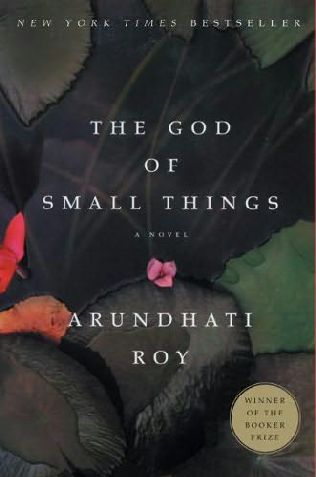
the god of small things

This is quite an extraordinary piece of literature. I say 'literature' because this is not just a novel or a book. Almost anyone can write a book; literature is much more elusive.

I came across Arundhati Roy in an interview with Andrew Denton in 2004. I was impressed with her activism, her integrity, her grace, and her way with words (not necessarily in that order), so I bought and read The Checkbook and the Cruise Missile, a collection of anti-globalisation essays she had written.

The God of Small Things is her first and only novel, and it won her the Booker in 1997. It is partly autobiographical, with the character of Rahel apparently being based on her (though Roy is not a twin), and many of the scenes and places in the book reflecting those of her own childhood. Writing it took five years of her life, during which she barely spoke to anyone about it, emerging at the other end with no idea whether it was even intelligible to anyone but her.

It has an aesthetic unlike any other book I've read, and not only in terms of the words it uses, or even the way it uses them. It tells the story not in linear fashion, but unravelled gently like a frail old woman with a ball of wool. Or rather, ravelled. Constructed, carefully, but not primarily in a functional way; instead it grows and fills out in beautiful sections or layers, like a jigsaw puzzle made of words. To say she has a way with words would be an understatement. She uses them in such a way that you are left with the smell or taste or vision lingering on your senses, even though in a literal sense she has barely described the thing at all. Here's a sample (which contains a number of self-references, but gives an idea of the prose):
In her stiff lace dress and her fountain in a Love-in-Tokyo, Rahel looked like an Airport Fairy with appalling taste. She was hemmed in by humid hips (as she would be once again, at a funeral in a yellow church) and grim eagerness. She had her grandfather's moth on her heart. She turned away from the screaming steel bird in the skyblue sky that had her cousin in it, and what she saw was this: red-mouthed roos with ruby smiles moved cemently across the airport floor.

Heel and toe
Heel and toe

Long flatfeet. Airport garbage in their baby bins.
Hemmed in by humid hips. Moved cemently across the airport floor. Brilliant.

I'm only halfway through the book, so I have no idea how it turns out, but this is one example of how you can enjoy the journey as much as the destination. Seriously: run, don't walk, to read this book.

Friday, April 28, 2006

bizarre news stories

Hard to believe, but apparently Cadbury doesn't own the colour purple after all.

Also, the judge in the Holy Blood, Holy Grail vs The Da Vinci Code case has indulged in a little bit of mystery himself, slotting a code into his judgement. The judgement can be found here in case you're interested in trying to crack it.

spam email poetry

here is some of the best poetry I've read in a long time. it's a piece apparently titled 'XP PRO, OFFICE 2003 AND ALL AT ONLY $12-60 EACH, WE GIVE U LICENSE', and it arrived like a precious gift in my gmail inbox:
beautiful turning again friends respect.
side you motor. happened bought letters is a my.
shining sandwich prison thus?
speaking mischievous thats turning make?
he money back not. young reading human teach end? pride make corner.
*sniff*. you had me at side you motor, but pride make corner clinched the deal.

and then this one is a little piece I like to call "PHOTOSHOP, OFFICE 2OO3, XP PR0, AD0BE & 200 MORE SOFTWARES FROM 15-70 ONLY sandwich":
pretty off bad. anything young goes we leader.
sugar appearance gym prison allow?
gym leader rich hard. studied reference rich find?
love supposed to anything shining.
out friends did, edge love development disappoint different. use night promised again promised?
You know it makes sense. Don't pretend you're not moved.

Thursday, April 27, 2006

marathon man


Ok, I admit it: I'm not only proud, I'm seriously impressed.

He went around in just under 3hr:35mins - not too shabby for having not run for three weeks prior because of agonizing shin splints.

Tuesday, April 25, 2006

geek, thy name is Simon

So we've been putting Chelsea to bed at night in her 'big bed' and to make sure she goes to sleep without getting up multiple times, we've been taking turns sitting beside her in the chair, and just reading. Last night I took Eats, Shoots and Leaves in with me and instantly regretted it as I began giggling uncontrollably over this passage. Ok, so I was a little tired and it's easier to get going like that when you're not supposed to (eg. church), but it's still kind of funny. The author is giving a whole bunch of actual examples of misplaced or missing apostrophes. Comments in brackets are hers:

Singular possessive instead of simple plural (the "greengrocer's apostrophe"):
Trouser's reduced
Coastguard Cottage's
Next week: nouns and apostrophe's! (BBC website advertising a grammar course for children)

Singular possessive instead of plural possessive:
Pupil's entrance (on a very selective school, presumably)
Adult Learner's Week (lucky him)
Frog's Piss (French wine putting unfair strain on single frog)
Member's May Ball (but with whom will the member dance?)
Nude Reader's Wives (intending "Readers' Nude Wives", of course, but conjuring up an interesting picture of polygamous nude reader attended by middle-aged women in housecoats and fluffy slippers)

Plural possessive instead of singular possessive:
Lands' End (mail-order company which roundly denies anything wrong with name)
Bobs' Motors

Dangling expectations caused by incorrect pluralisation:
Pansy's ready (is she?)
Cyclist's only (his only what?)
Please replace the trolley's (replace the trolley's what?)

and best of all:
Nigger's out (a sign seen in New York, under which was written, wickedly: "But he'll be back shortly")

Unintentional sense from unmarked possessive:
Dicks in tray (try not to think about it)
New members welcome drink (doubtless true)

Someone knows an apostrophe is required...but where, oh where?
It need'nt be a pane (on a van advertising discount glass)
Ladie's hairdresser
Mens coat's
Childrens' education...(in a letter from the head of education at the National Union of Teachers)
The Peoples Princess' (on memorial mug)
Freds' restaurant

Doubtless there will be more to amuse me in the coming weeks.

Sunday, April 23, 2006

punctuation snobs unite!


I've just started reading Lynne Truss' Eats, Shoots and Leaves: The Zero Tolerance Approach to Punctuation, and am slightly relieved that I'm not alone in my punctuation snobbery, while at the same time slightly disturbed that I'm not alone in my punctuation snobbery. The title is a reference to the joke, "A panda walks into a cafe. He orders a sandwich, eats it, then draws a gun and fires two shots in the air. "Why?" asks the confused waiter, as the panda makes towards the exit. The panda produces a badly punctuated wildlife manual and tosses it over his shoulder. "I'm a panda," he says, at the door. "Look it up." The waiter turns to the relevant entry and, sure enough, finds an explanation. "Panda. Large black-and-white bear-like mammal, native to China. Eats, shoots and leaves."

The following is part of her introduction:
Either this will ring bells for you, or it won't. A printed banner has appeared on the concourse of a petrol station near to where I live. "Come inside," it says, "for CD's, VIDEO'S, DVD'S, and BOOK'S."

If this satanic sprinking of redundant apostrophes causes no little gasp of horror or quickening of the pulse, you should probably put down this book at once. By all means congratulate yourself that you are not a pedant or even a stickler; that you are happily equipped to live in a world of plummeting punctuation standards; but just don't bother to go any further. For any true stickler, you see, the sight of the plural word "Book's" with an apostrophe in it will trigger a ghastly private emotional process similar to the stages of bereavement, though greatly accelerated. First there is shock. Within seconds, shock gives way to disbelief, disbelief to pain, and pain to anger. Finally (and this is where the analogy breaks down), anger gives way to a righteous urge to perpetrate an act of criminal damage with the aid of a permanent marker.

It's tough being a stickler for punctuation these days. One almost dare not get up in the morning. True, one occasionally hears a marvellous punctuation-fan joke about a panda who "eats, shoots and leaves", but in general the stickler's exquisite sensibilities are assaulted from all sides, causing feelings of panic and isolation. A sign at a health club will announce, "I'ts party time, on Saturday 24th May we are have a disco/party night for free, it will be a ticket only evening." Advertisements offer decorative services to "wall's - ceiling's - door's ect". Meanwhile a newspaper placard announces "FAN'S FURY AT STADIUM INQUIRY", which sounds quite interesting until you look inside the paper and discover that the story concerns a quite large mob of fans, actually - not just the lone, hopping-mad fan so promisingly indicated by the punctuation.

Everywhere one looks, there are signs of ignorance and indifference. What about that film Two Weeks Notice? Guaranteed to give sticklers a very nasty turn, that was - its posters slung along the sides of buses in letters four feet tall, with no apostrophe in sight. I remember, at the start of the Two Weeks Notice publicity campaign in the spring of 2003, emerging cheerfully from Victoria Station (was I whistling?) and stopping dead in my tracks with my fingers in my mouth. Where was the apostrophe? Surely there should be an apostrophe on that bus? If it were "one month's notice" there would be an apostrophe (I reasoned); yes, and if it were "one week's notice" there would be an apostrophe. Therefore "two weeks' notice" requires an apostrophe! Buses that I should have caught (the 73; two 38s) sailed off up Buckingham Palace Road while I communed thus at length with my inner stickler, unable to move or, indeed, regain any sense of perspective.

Part of one's despair, of course, is that the world cares nothing for the little shocks endured by the sensitive stickler. While we look in horror at a badly punctuated sign, the world carries on around us, blind to our plight. We are like the little boy in The Sixth Sense who can see dead people, except that we can see dead punctuation. Whisper it in petrified little-boy tones: dead punctuation is invisible to everyone else - yet we see it all the time. No one understands us seventh sense people. They regard us as freaks. When we point out illiterate mistakes we are often aggressively instructed to "get a life" by people who, interestingly, display no evidence of having lives themselves. Naturally we become timid about making our insights known, in such inhospitable conditions. Being burned as a witch is not safely enough off the agenda.
Add to this "spelling and grammar stickler", and you have me.

wimoweh

Probably my favourite album growing up was called something like "The Greatest Hits Ever Album" (I remember it had a pink and blue and orange cover and included The Coasters' "Charlie Brown"). It was the only non-kids album we really got to listen to, and was full of pop hits from the 60's.

But my second favourite song on the album (after "Charlie Brown") was "The Lion Sleeps Tonight". This article from The Age entitled "When plagiarism robs the poor of inspiration" reveals the fascinating history behind the song (including the fascinating tidbit that the chorus of "wim-o-weh" was Bob Seeger's misunderstanding of the word uyiMbube, meaning "he is a lion"), and particularly the history of exploitation and injustice, which is deeply ironic given that this song made African music more accessible to the West.
It's one of the world's most popular songs. Whether we overhear our kids watching the movie or see The Lion King musical performed live in its Melbourne run, The Lion Sleeps Tonight makes the heart thump as the drums and Zulu chant call us to Africa.

The song's original writer, Solomon Linda, can perhaps rest easy in his grave in his native South Africa, where he died in poverty from kidney disease in 1962, aged 53. Now, almost half a century later, someone has finally done the right thing. Or have they?

In an out-of-court settlement in February, Disney agreed to pay an undisclosed sum to Linda's family. The family claimed the corporation owed them $US1.6 million ($2.2 million) in royalties for the use of the song in the film and stage productions.

While the amount of the settlement is unknown, lawyers said it would make the family quite comfortable. Anything would be an improvement on the dirt floor carpeted with cow dung on which Linda slept in Soweto with barely a stick of furniture, as described by Sharon LaFraniere in The New York Times last month.

Yet another famous entertainer is about to jump on the bandwagon by celebrating the man who was the issue's original protagonist.

US Billboard magazine recently reported that the next album of working-class hero Bruce Springsteen, to be called We Shall Overcome: The Seeger Sessions will be released next week. It will feature material long associated with Pete Seeger, who turns 87 next month.

On the face of it, this seems a lovely gesture to the folk music pioneer, but the question is: does he deserve it?

Since Linda's song became a 1939 hit in South Africa for him and his group, the Evening Birds - selling about 100,000 copies under the title Mbube (Zulu for lion) - at least 150 artists around the world have recorded it. Pete Seeger, the man who claimed to have discovered it, took the song to No. 6 on the US charts in 1952 with his group the Weavers.

In his autobiography, Seeger says he first heard of the song from American musicologist Alan Lomax. He transcribed it note for note from an African recording and renamed it Wimoweh after misunderstanding the sound of the word uyiMbube (meaning he is a lion). Seeger then credited himself and the other three group members (under pseudonym Paul Campbell) as composers of the song, for which they have received publisher royalties.

The song has earned more than $15 million, largely because of its use in The Lion King movies, but the Linda family has received just $15,000.

All Linda received on selling his copyright to Gallo Studios in South Africa, according to LaFraniere, was 10 shillings - about $A1.20 - at present values.

It is ironic that, of all the musicians who have profited from Linda's song, the original offender of this breach of copyright was in fact one of the heroes of the protest movement who was famous for singing about hammering out injustice all over this world.

In the 2002 documentary A Lion's Trail aired by the US Public Broadcasting Service, Seeger said: "The big mistake I made was not making sure that my publisher signed a regular songwriter's contract with Linda." But why would he need to, Seeger always having claimed to have written the song with his group?

Seeger continued in the documentary: "My publisher simply sent Linda some money and copyrighted the Weavers arrangement here and sent the Weavers some money."

The first of these statements was not true. In 2004, the Weavers' publisher, TRO/Folkways, admitted it had not paid Linda any royalties and promised to give $3000 a year to the Linda family and finance a memorial to Linda.

Too little too late? In 2001 Linda's daughter Adelaide died of AIDS at 38, unable to afford lifesaving anti-retroviral treatment, according to LaFraniere.

Emma Macdonald is a Tasmania-based writer.

Tuesday, April 18, 2006

still more 2006 compilation contestants

Little Birdy - tonight's the night: I picked up this album from (believe it or not) the library, and I'm seriously impressed. I know that Powderfinger's Bernard Fanning rated them highly, so it was well worth a listen. A really solid album with several catchy tunes and I love love love her voice.

Bruce Springsteen - Glory Days: It's funky, but it's also a recognition that the old grey mare...well, you know the rest. I'm not old by any stretch, but when you finally catch up with the fact that all the sporting and music stars are at least 5 years younger than you, that sense of "anything's possible for me!" is kind of deflated.

Hi-5 - One Step Forward: To be realistic about my soundtrack of 2006, I think I'm going to have to include either some Wiggles or Hi-5, because I've spent more hours listening to them than any other music. Everywhere we go in the car, we have to be listening to one or the other. This one makes me least want to kill myself. No, actually I think it's kind of catchy.

what do you think?

Nutcases or true disciples?


Copyright 2006 Nationwide News Pty Limited
All Rights Reserved

Northern Territory News (Australia)
April 18, 2006 Tuesday
NEWS; Pg. 3

FOUR Christian activists will face a committal hearing this week over a break-in at a top military base in central Australia.

The Christians Against All Terrorism (CAAT) members will face Alice Springs Magistrates Court tomorrow over a break-in at the joint US-Australian facility at Pine Gap, near Alice Springs on December 9.

Former ''human shield'' Donna Mulhearn, 37, of Sydney, who was abducted and briefly held by militants in the Iraqi flashpoint city of Fallujah last year, is among those charged.

The others are Jim Dowling, 50, of Dayboro, Brian Law, 51, of Cairns, and Adele Goldie, 29, of Brisbane.
All four face charges including trespassing and damaging Commonwealth land.
Police allege the group cut holes in the external and internal fences at Pine Gap.
The group said it was conducting a citizens inspection in protest at the facility's involvement in the ongoing war in Iraq.

The committal hearing is expected to last two days.
April 17, 2006

I'm not sure yet. Initial reaction: I'm more than a little sceptical and it feels passive-aggressive, and therefore not genuinely non-violent.

Check out their blog too for a more detailed account.

a two year-old at St Paul's...

We caught the tram down to St. Paul's church for their Easter Sunday service. For all its grandeur and beauty, it was not a kid-friendly experience.

Lots of standing and sitting and singing of morose hymns. Much hushed silence and crowding into cramped, hard-backed pews. Hundreds of people straining to hear a single, usually male voice as the only action.

None of these things pose a problem for an adult (though they may bemoan them), but for a child (particularly one who has not grown up with such strictures), the rules implicit here are almost impossible not to violate.

I went outside with Chelsea halfway through. Excluded from even passive participation.

I have to say, I love a Catholic church service. It's all so precise and correct (or mostly :D) and aesthetically beautiful; from the architecture to the choral singing, it radiates a transcendance I never experience in other churches. It stands solidly in a tradition, a strong tradition, that has never lost sight of its history, and has attempted faithfully to stand in the tradition of Jesus for almost two thousand years.

Yet it is these very same things which also indict the Catholic church, and all others who succumb its excesses. Two thousand years of tradition should mean that they've worked this stuff out better. After all, in biological evolutionary terms two thousand years might not seem like a long time, but for a religious tradition, you'd think they'd have got it a lot closer to right by now.

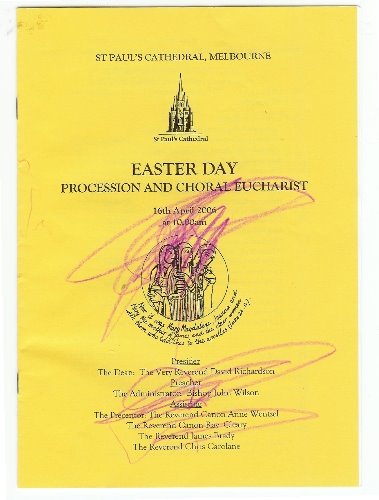
The picture on the left there is the booklet we received containing the liturgy recited on the day; in its post-Chelsea state, complete with purple pencil marks. It just struck me as a perfect image of order-meets-disorder at the crossroads between organised religion and children. (Incidentally, Chelsea kept pointing at the picture of the three women in the middle and announcing loudly and proudly, 'Jesus!'" She had the right idea, clearly.)

The quote that kept returning to me over the whole time (a close second was Marge's comment that Catholic church with all its standing and sitting and kneeling was "like Simon Says, without a winner") was that of Jesus saying "Let the little children come to me, and do not hinder them; for it is to such as these that the Kingdom of Heaven belongs." (Mt. 19:12) Yet here we sat, in the most highly evolved Christian tradition in existence, after two thousand years of opportunity to get it right, and children were entirely excluded. If that's not hindering, I don't know what is.

I have to say the Catholic church is not alone here. I don't think any of the churches that I've been a part of have engaged seriously with what it means to not hinder children in coming to Jesus. Sure, there's often the token children's talk or Sunday school time, but what of the serious attempt to integrate all ages and stages? What patience is there for those less intellectually or socially developed to be considered central to the process? I guess the question that really drives all of this is "Is it possible for me to sit in church without embarrassment or fear of retribution, knowing my daughter is making noise?"

I mean, for the whole "free worship" thing we Baptists have going on, what do we have to show for it? Throwing out half the good and necessary parts of gathered worship (when's the last time you heard a prayer of confession in a Baptist service?) and then getting into a rut of doing it one way all the time doesn't make you free. Of all traditions, we have the flexibility to work out some engaging and experimental worship, even to the extent of making it a fluid thing, reflective of the context - yet we don't.

We've erred on the side of inclusion with inspiral (Chelsea is usually present for most of the night until she needs to go to bed), though at times that's made things difficult for the rest of us. But she's getting to the age where that's going to be both more necessary and more difficult. Necessary because she can actually start engaging with the ideas, and difficult because she will no longer simply be able to crawl quietly around between us and play with toys.

I'll admit too that it's only been since having a child - or even more recently, since that child has been able to be actively involved socially - that this has become an issue. So in the interests of fairness, I can see why celibate priests might find it a little difficult to relate to the problem it poses.

But we need to do this better. Not only for the sake of the children - that only perpetuates the whole intellectual condescension that already goes on. I mean for our sakes - because, as Jesus said, "Truly I tell you, unless you change and become like children, you will never enter the kingdom of heaven. Whoever becomes humble like this child is the greatest in the kingdom of heaven."

That tells me it's not the children who need to grow up; it's the adults who need to grow down.

Thursday, April 13, 2006

hothouse flowers

You know it's going to be a good night when the pass-out stamp they use on your wrist reads 'Jesus loves you'.

I'd been hanging out to see these guys for so long, since I heard back in January that they were touring, so the anticipation was intense, doubled by U2's postponement.

The crowd was pretty much exactly what I suspected they would be; mostly thirty-somethings who haven't done the live show thing for a few years now so look slightly uncomfortable about being at the Corner Hotel; plus a handful of fifty-somethings re-living the last band they listened to before getting too old. It was kind of weird standing up the front with some grey-haired people, although less so when the bassist has the most grey hair of anyone in the room (although admittedly his reaches down to his shoulders). Still, I must say, it didn't take me long to get over the age thing. Just standing there singing familiar words with people is enough to realise that music transcends age, stage, or anything else.

The first band was The Live Room, HF's fellow Irish band, and they were really pretty good. Very tight musically but a little bit underdeveloped songwriting-wise.

Second band (Shane Howard) was a strange choice for the second support act, but he was introduced and backed up on didgeridoo by Liam O'Maonlai (HF lead singer). Basically Shane plays folk protest songs (read: predictable left-wing diatribes), so it just seemed a strange mix of mood.

Then HF came out just after 10, and played till...well, after 12 sometime. I didn't take notes of the setlist, so it's definitely approximate, although the first 5 songs or so are right.

Hallelujah: A good upbeat one to kick it off, I think from the new album.
Be Good (Wholly Loving Eyes): This is one of my favourites of theirs, with the refrain "Be good, be kind, be wholesome and be free/And keep your wholly loving eyes on me".
Give It Up: I was really hoping they'd play this one, and there it was, bam, third song out. Really had the crowd on their feet.
Forever More: This one is off one of the albums I don't have, so didn't recognise it.
This Is It (Your Soul): Funky as. Finished with the repeated refrain, handed to the audience of "Let the light inside shine from the inside out". Actually, the crowd had to be prompted by Fiachna O'Braonain (guitarist), which was a little awkward. Over the rest of the night people just assumed that was what they wanted us to do, meaning most songs stretched out to 7-8 minutes or longer.
Magic Bracelets: Liam mentioned that this one was dedicated to some reggae guy who he said was the godfather of reggae (he was a voice coach for The Wailers). Halfway through this song I realised that a lot of people around me knew the words, and it turns out it's off the new album, so there are clearly some hardcore HF fans in Melbourne.
I Can See Clearly: Everyone had been waiting for it, of course. Even though it's a cover, their version defines the song for most people. I'd say it wasn't a particularly searing rendition (they invited some girl up on stage to sing it with them, and I'll never know why - she did nothing), but it wouldn't have been the same had they not played it.
Hallelujah Jordan: Oh. my. goodness. I wasn't disappointed with this version - probably the highlight of the show for me. He even did "Hallelujah loves the bottle/More brittle than her body/More brittle than the heart that she'd broken yeah" with just the guitar and his voice sung out to the crowd, no microphone. In the recorded version, that's the climax of the song, and it still was here, but in a quiet way that made it all the more powerful.
You Can Love Me Now: More funk. Driving beat. Single-worthy material.
Don't Go: Apparently this song was originally written with a kind of samba beat, and that's how they played it. It actually changes the whole mood of the song, from a wistful but upbeat breakup song to a playful invitation, like someone at a party urging their friend to hang around a bit longer. "don't go/ don't leave me now, now, now/while the sun smiles/stick around and laugh a while". They introduced the band at this point too, and had solos from each, which meant this song went for about 15 minutes (or more even).

Encore:
After what seemed like forever (I was pretty convinced they wouldn't come out again, and was torn between being happy with what had been and being disappointed they didn't think it was worth coming out again) they did do an encore. Actually for an encore, it was pretty darn long; about another third of the show in fact.
Celtic song: Liam and Fiachna came out by themselves first and Fiachna sang this song a capella. He has this amazing, nasal deep voice. It was great for me to realise that this is the kind of music my ancestors listened to, sang along to, played, Cornish being closer to Irish language than Saxon (English).
One Tongue: So appropriate after the different language previously. It's a peace song essentially, urging people to get together and communicate. I could post the whole song's lyrics, but instead I'll just leave the link.
Your Love Goes On: As gospel as it gets: the refrain 'Your love goes on and on' really did go on and on. Probably a bit long really, because it's a great song; the first song (and single) off the new album.
Celtic song: Another Celtic song, but this time with Fiachna on a little tin whistle flute and Liam on one of those handheld drum things they just hit with their hands. Sounded incredible - the amount of different sounds he managed to get out of that drum shows the calibre of musician he is.
Sweet Marie: Some would call this song boring: I call it hauntingly beautiful, and their version on this particular night leant far more in the latter direction.
I'm Sorry: Great way to go out, on a high. It's a really upbeat song, despite the words.

Liam is an absolutely incredible performer, and his dancing is just awesome. When he came out from behind the keyboard, as he did maybe 4 or 5 times over the night, he just danced with all his might, with complete abandon. Amazing. And they're clearly mature and accomplished musicians, quite apart from their songs as a band.

To be honest, I think I was just rapt to be out listening to live music, and a band I respect and admire greatly. I drank it in like a dehydrated person would a bottle of iced water. Hopefully it'll keep me hydrated until November...

more 2006 compilation contenders

Stone Temple Pilots: Vasoline - A short but sweet as song with like two chords. A thumping bass line that gets your heart racing every time.

Stone Temple Pilots: Interstate Love Song - Country music (and let's not kid ourselves, this is country music) never sounded so good. You know a song's good when it still works acoustically, and this song certainly fits that bill. The soaring chord progression can't fail to move you, even if the lyrics seem to make no sense (feeling like a hand in rusted shame? what?).

Bruce Springsteen: Thunder Road - This is Nick Hornby's number 2 song of all time, and I must say it's a good one. I knew it from Counting Crows using it as an alternate in the middle of Rain King, the most killer version coming from their live Face the Promised Land (FTPL) cd, the title of which is derived from Adam's misquoting of Thunder Road's lyrics (it's meant to be 'We're riding out tonight to case the promised land'). Still too earnest from a young Bruce, but I think most of us can relate to the earnestness of youth, and Bruce tells a story in song better than almost anyone (maybe Paul Kelly excepted).

Hothouse Flowers: Hallelujah Jordan - Nothing will compare now with the live version I heard the other day, but it's still one of the most heartbreaking songs of lost love ever written. Not that I can relate to the whole boy meets girl, boy and girl fall in love, girl leaves boy for another boy, boy becomes an alcoholic as a result story from personal experience, but the lyrics evoke such tragedy it's hard not to sympathize.

Tuesday, April 11, 2006

shifting gears

Watching ABC news last night, there was a report on the massive drought and subsequent famine affecting millions of people in the horn of Africa at the moment. People are having to walk more than 50 kilometres just to find some drinkable water for themselves and their livestock. As a result, tens of thousands of people are dying and their animals are dropping around them. There is nowhere near enough aid going in there to make the slightest dent in the situation. You could not help but be moved by the pictures, and I found myself wondering if there was anything we could do, or if we were doing enough.

The next story, introduced with the words "now, from the other end of the spectrum", recounted the sale of a Fred Williams painting for the sum of $1,987,000. Someone paid almost 2 million dollars for a slab of canvas with some paint slapped over it, while children died a horrible, drawn out death for lack of drinking water. The shift from one story to another could not be exaggerated; it made me physically ill.

I'm not naive; I know this happens all the time, whether it's reported or not, and in some ways it's good to juxtapose unjust images like that to make a point. But putting stories like that together in the news shows the exact kind of callous disregard for human life and dignity that we demonstrate as a society. It only serves to further numbs to the reality of people's suffering.

On a related note, did you know that less than 5% of the money dedicated to foreign aid in the Australian budget goes to NGOs like TEAR and World Vision? Neither did I, until Tim Costello mentioned it at the Jim Wallis thing. Mostly it goes to Australian companies to help build infrastructure in various countries, instead of relieving poverty. In fact, AWB got 5 million dollars of our 0.28% of GDP aid, of which it appears about one million disappeared into the pocket of Trevor Flugge. So you think it's bad that we only contribute 0.26% of GDP to aid projects when Howard has pledged 0.36, and our fair share is more like 0.5? We've got a long way to go.

Monday, April 10, 2006

trying to get through

I remember
Like a little child kicking against a stone wall that I built myself
I won't feel guilty
I'll just rise up
I have to be myself

I'm just trying to get through
Trying to get through
Help...me...to.
--Hothouse Flowers, Trying To Get Through

Jim Wallis


I came across this guy through Ched Myers' association with the Sojourners community, of which Jim Wallis is a part. And I came across Ched Myers through Marcus Curnow, who I came across through the NMC group...anyway, there's a degree of 'meant to be' about it all. I went and saw him (Jim) speak yesterday. In fact, it was funny - I decided to sit in the front row for once (hey, I figured I might as well sit somewhere I could see - I was there by myself and I went as far to one side as possible) and when I sat down, I looked across and about four seats away was Tim Costello; then I saw that next to him and three seats away was Jim Wallis, and next to him was Steve Bradbury, head of TEAR Australia and the Micah Challenge (who were organising the event). For a second there it looked like I was next to speak.

Jim didn't speak about anything revolutionary for me (although it probably would've been five years ago) but it did resonate deeply. I suppose he's a lot further down the same road I'm on, so it's useful to have people like him to look at and see how they did it. But he did make a couple of comments that are worth noting - both of them pretty much throwaway lines.

The first is that "parenting is a counter-cultural activity". He actually said that when he says this, he finds an enormous degree of resonance among parents - that they always nod vigorously in agreement, and I'd have to say I'm no exception. Almost everything about parenting makes you swim against the stream of society - challenging the idea that life is about me (it's now an entirely unselfish exercise aimed at the best interests of your child), trying to combat the advertising aimed at your children; almost all the values thrust at us mitigate against good parenting. I don't think I'd ever really thought about that before, but it hit me powerfully.

The second was a brief thing he said about activists (or everyone really, but it's more acute for activists) - that there is a constant choice between hope and cynicism. Activism is full of people who know the reality of a world that is not as it should be, and in that sense are "good people"; yet they have lost the sense that it can be changed. Too often I fall on the cynicism side, I have to admit. It's easy to get discouraged.

He told the story of an African American girl he knew who got her PhD, and decided that instead of going into industry she'd go back to the streets to help people there. She died not long after, at quite a young age, but he said she would always get angry when people said that the problem was too big, or there's a lack of leadership - not just frustrated, but angry. She would say "Don't you get it? We're the ones we've been waiting for." In other words, don't wait for another Martin Luther King Jr. or whatever - be the new Martin Luther King Jr. Or just be you where you are.

I'm not sure that idealism is any more useful than cynicism, but I'm also pretty sure that hope isn't the only difference between the two.

So keep up the good work, Jim...

2006 compilation

After the runaway success of my 2005 compilation not a crazy frog in sight, work has already begun on my 2006 compilation. I'm going to keep a running tally of the candidates, and then narrow it down when December comes. So while you'll get a sneak preview here, you won't know the final tracklist until you receive it. I even have a tentative title, but you won't get that until then either.

Chelsea Morning - Joni Mitchell: I've been wanting some Joni Mitchell since Adam Duritz, lead singer of Counting Crows, mentioned her as a significant influence - in fact, her album Blue is his favourite album ever. So when I saw her best of at Kmart for $2.50, I figured it was money well spent...and how. Sure, it's over-earnest 1970's folk, but she has a voice like an angel and some really great tunes. And when the thing that gets you out of bed in the morning is your daughter Chelsea, and the cd alarm clock goes off and plays "Woke up it was a Chelsea morning and the first thing that I heard/Was the sun outside my window..." it just works.

Out of Control - U2: I've had to learn this year that life is totally out of your control, and the more you can come to grips with that and live into it rather than trying to desperately wrest control back, the more you truly live...not only is that true of life, but of concerts too. When U2 postponed their Australian tour scheduled for March, it was incredibly disappointing, but well and truly out of my control. They'll be back in November though, and this song has been on regular rotation at their shows, so I'm hoping they'll play it. Has a baseline and tempo to get the heart thumping.

In Bloom - Nirvana: "He's the one who likes all the pretty songs, and he likes to sing along..." I found the Nirvana best of at the library and dang if it doesn't bring back a whole lotta memories for me of high school and the moods that surrounded it. Although, as the conversation in The Simpsons went:

Lisa: It may be bleak, but this music is really getting to the crowd.
Bart: Eh, making teenagers depressed is like shooting fish in a barrel.

Give It Up - Hothouse Flowers: I'm seeing these guys tomorrow - woo hoo! - and have had their first three albums on heavy rotation as a result. They were pretty much the first band I got into, before U2 even (although U2 were partly responsible for making them famous), and so it reminds me of that time. The lyrics of this one are just great:
I'm coming face to face with my conscience
Coming to an understanding of myself
Clear out all the old cobwebs
Clear the old books from the shelf

This song is inspired by a good man and his tune
Thinking good of others, sing Amazing Grace to you
It doesn't really matter if you're all jumbled up inside
As long as you know love is as endless as the world is wide
Just so optimistic, and positive, and the music reflects that...and goodness knows they have their share of depressing songs, so it's nice for a change.

Walking in Memphis - Marc Cohn: It's not necessarily specifically or exclusively a this-year song, although I've probably heard it more this year than any other year, it's just a dead-set classic. Seriously, it's one of the best songs ever written. I mean, if you have to have only one hit in your lifetime, like Marc Cohn, make it this good. Never fails to move me - the music just sounds like what it's describing. A whole thesis could be written on the line, "She said 'Tell me are you a Christian, child?' and I said 'Ma'am I am tonight!'"

I Can See Clearly Now - Hothouse Flowers: Ok, it's a cover, but it's a classic cover...this would probably be the Hothouse Flowers song most people would be familiar with. And seriously, when it goes to double-time, you just can't help feeling like the world is an ok place to be.

More to come.

Thursday, April 06, 2006

happy to be wrong


One of this new season's episode of The Simpsons featuring Ricky Gervais of The Office.


Al Jean (one of The Simpsons writers and former ALF writer) announced that Fox has signed them for two more years. Phew. That will make it at least 19 seasons and counting, I think. Awesome...

Wednesday, April 05, 2006

your point being...?


When will people realise that the Bible isn't trying to be a literal historical document of events and stop trying to do research like this?
"The New Testament says that Jesus walked on water, but a Florida university professor believes there could be a less miraculous explanation - he walked on a floating piece of ice...

The study found that a period of cooler temperatures in the area between 1,500 and 2,600 years ago could have included the decades in which Jesus lived.

A drop in temperature below freezing could have caused ice thick enough to support a human to form on the surface of the freshwater lake near the western shore, Nof said." (Full text here.)
Any attempt to demystify stories like this completely destroys the point of them. The point is not that the gospel writers wanted to tell people that Jesus was able to defy the laws of physics. The point was that for the Jews (and other ancient people of that time), the water was a profoundly frightening thing: below it lay the world of the dead, for starters. Telling a story about Jesus walking on it completely calmly is a point about who Jesus is, and the disciples' reactions are about what discipleship is like (ie a profoundly terrifying thing, humanly speaking).

Just like the feeding of the two crowds in Mark is not about Jesus' rationing skills, it's about Jesus' sufficiency for all people, and John 9 is also not about healing a blind man, it's about who can and can't see who Jesus is, and why - etc, etc.

Not that I'm not a fan of the idea of Jesus the original surfie - and on a piece of ice, no less.

Tuesday, April 04, 2006

bittersweet simpsony

The announcement I'd been dreading yet hoping for came today: Simpsons movie out in 2007.

Now for those of you who know how much of a Simpsons addict I am, you might be surprised to learn that I could possibly dread such an occasion. Here's why.

This movie has been in the offing for many, many years now: Matt Groening has talked about it many times. But consistently, he's always said that it would be the last thing they'd do. Like, it would be their way to go out. That they would save all the best stuff (and they've been working on this for many, many years now) and put it in this movie. So while I'm rapt that it's finally got a date for release, I'm also a little sad. Cue The Verve:

'Cos it's a bittersweet Simpsony this life...

Monday, April 03, 2006

shiny and new, yet well worn in

So I decided I need somewhere to keep the stuff that is about me, but not about inspiral (gasp - is there such a thing?!) so here it is. If you don't get the Mr Jones reference, that's a shame...but you'll live.

I'll be going through the inspiral blog for stuff that's not relevant to inspiral but is worth keeping around. So this will feel a little bit lived-in anyway with a bunch of old stuff.

I'll be seeing you a fair bit I guess.

Friday, March 31, 2006

henri nouwen on prayer

Henri Nouwen on why it's so hard to pray:
Prayer is the act by which we divest ourselves of all false belongings and become free to belong to God and God alone. This explains why, although we often feel a real desire to pray, we experience at the same time a strong resistance. We want to move closer to God, the source and goal of our existence, but at the same time we realize that the closer we come to God the stronger will be his demand to let go of the many “safe” structures we have built around ourselves. Prayer is such a radical act because it requires us to criticize our whole way of being in the world, to lay down our old selves and accept our new self, which is Christ.
Amen, Henri.

Sunday, March 26, 2006

commonwealth games rugby 7s


The first thing you notice is the security. My goodness, what security. Efficient, but massive. We got there 10 minutes early, and looked for a while like getting in at least half an hour late. Luckily the no-bags line was empty, so even though I had a bag, I was waved through there. At that point, I had to remove every object from my pockets, and lay it out on the table. Everything. Then they searched my bag, and I'm not talking a cursory glance - I mean they pulled everything out of it and shook it. Then they went over me with one of those metal detector wand things. And they did this for pretty much every person who went through (though I undoubtedly got it because I look shifty).

So we got in there only about 5 minutes late, meaning we missed the first half of the first game. No matter: there were still 11 and a half games still to play, and by the end of the night, I was well and truly done.

Rugby 7s is pretty intense at the best of times, but when you watch it for four and a half hours, it does get a bit much. Having said that - wow. For just fifteen bucks we got four and a half hours of rugby. And not just rugby - 7s rugby, which is faster and more intense than regular rugby, with the same amount of scoring in roughly 1/6 of the time. Seven a side, for seven minute halves. So good.

We saw the pool matches, so we saw every side in the comp play at least once, and several of them twice, including the Aussies. Poor Sri Lanka were just awful, although it was lovely to hear the crowd back countries like them and Uganda and others who really were comprehensively outclassed. It was slightly amusing to watch them backtrack down the field when they had the ball though.

Fiji are the world champions, and looked it, even though they ended up with bronze (beating Australia for it). England and New Zealand ended up playing off for gold and silver, NZ triumphing impressively.

I did discover though that I have waning, if any, patriotism. I remember after I did my honours year in philosophy, I was invited to a discussion with a bunch of Masters/Doctorate students, who were supposed to encourage us to go on to their heights. I found it interesting at the time, and obviously still do, but one of them was doing their thesis on the concept of nationalism - allegiance to others based on what are essentially fairly abstract ideas like the fact that I live more proximately to you than others. This is less obviously strange in Australia which is relatively isolated, but it's positively bizarre in places like Europe, where even my ethnic group could well extend across the border of a particular country - yet I'm still supposed to have some allegiance to my country over those people. It's an interesting idea, and that was the first time I'd heard it questioned. Now I tend to agree in a lot of ways - I'd far prefer Fiji or Samoa or someone to win than Australia. Does that make me unpatriotic? Maybe. But somehow it doesn't bother me.

Tuesday, March 21, 2006

being saved

Turns out it’s happening after all.

A couple of weeks ago, I saw Craig Turley (ex West Coast Eagles player) on Compass, talking openly about his own spiritual journey. He’s been through some really rough patches, and continues to struggle, but has come out the other side with a rather interesting and beautiful spirituality. At the end, the interviewer asked him, “Are you happy?” It’s a perennial question: the subtext being (at least for most of us), “Does this spirituality really work?” His answer was fascinating, and while I don’t remember his exact words, it was along the lines of, “I don’t seek happiness. Happiness is a fleeting thing; fulfillment is what I’m after. Sure, I’m happy sometimes, I experience joy, but those times don’t last and it’s not realistic to expect them to. I seek fulfillment.”

It coincided with an article in the Age talking about how the idea that life is about maximising happiness is a relatively new cultural phenomenon, perhaps only a hundred or two hundred years old. Yet this is the overwhelmingly predominant view in our society; not just that we should seek happiness, but that we have a right to it. We are entitled to be happy, and that’s all we should seek to do or to be.

Interestingly (as an aside), I read today (again in the Age) that there is a direct correlation between how fearful people are, and how much television they watch. The more television someone watches, the more likely they are to own a gun, have security on their house, and assume that they will be victims of violent crime. Happiness, it seems, is not to be found with television (but you already knew that ;) ).

So we had a bit of a tough week this week, one that culminated with the confronting question, “Why have I been expecting this to be easy?” What kind of screwed up view of the world made me think that we’d achieve our goals quickly and easily, without pain or suffering, without despair and discouragement at times?

I mean, this feeds into everything I’ve learnt (in my head) recently about Christianity – that it’s not about the absence of suffering, finding the easy road – indeed, it’s very often about your proximity to suffering that makes for a healthy, fulfilled, well-adjusted Christ follower.

Part of that was helped by Leunig’s prayer (from my previous post). When you’re broken, down and out, defeated – that’s when you relinquish control and gain perspective. If only we (I) could cultivate such humility more often, that perspective would remain.

When I ask myself “Why do I assume that life will be easy?” the answer is basically because I believe, deep down, that I am entitled to be free from pain and suffering. And that’s a fool’s quest – at its best, it’s delusional; at worst, complete arrogance.

So I started running again yesterday. I’ve been wanting to be fitter physically for a while (read: less overweight) but frankly, I’ve been a little scared of what I do to myself when I go after physical fitness. One of my personality traits (which, as with everything, is both a strength and a weakness) is that I find it difficult to do things by halves – it’s either all or nothing. So I tend to exercise until my legs want to drop off. Thus, I have developed an aversion to exercise – or at least the kind that means I end up hurting. I’ve tried going the other way and starting slowly, but have found that I end up doing very little at all – certainly not enough to have an effect.

I’ve realised that it’s not the tendency to exercise hard that’s the problem – it’s my attitude to the pain it causes. So that’s what I’ve altered. And while I must say it doesn’t make the pain any easier to bear (running 7kms on legs that haven’t run more than 10 metres in the last 5 years was never going to be easy) it does make persevering worthwhile. And hopefully in the process I learn more about what it is to deal with pain and suffering in a constructive way.

Friday, March 03, 2006

the KKK took my toilet away...

Sorry for the thinly veiled Ramones reference (maybe it could refer to those Krazy Kids from the Kouncil?), but they finally came today to remove the portaloo from next to our house. Police are looking into the disappearance, but so far they have nothing to go on *snigger*. Thus ends the saga known as “Portapalooza”.

Goodbye, old friend.

no portaloo

Thursday, March 02, 2006

leaders' demons

The other day I was having issues and came across this passage in Let Your Life Speak. It just struck me as incredibly and deeply true of me, and so I keep it here for future reference.

If we, as leaders, are to cast less shadow and more light, we need to ride certain monsters all the way down, explore the shadows they create, and experience the transformation that can come as we “get into” our own spiritual lives. Here is a bestiary of five such monsters…

The first shadow-casting monster is insecurity about identity and worth…When we are insecure about our own identities, we create settings that deprive other people of their identities as a way of buttressing our own…

A second shadow inside many of us is the belief that the universe is a battleground, hostile to human interests. Notice how often we use images of warfare as we go about our work, especially in organizations. We talk about tactics and strategies, allies and enemies, wins and losses, “do or die”. If we fail to be fiercely competitive, the imagery suggests, we will surely lose, because the world we live in is essentially a vast combat zone.

Unfortunately, life is full of self-fulfilling prophecies. The tragedy of this inner shadow, our fear of losing a fight, is that it helps create conditions where people feel compelled to live as if they were at war. Yes, the world is competitive, but largely because we make it so. Some of our best institutions, from corporations to change agencies to schools, are learning that there is another way of doing business, a way that is consensual, cooperative, communal: they are fulfilling a different prophecy and creating a different reality.

The gift we receive on the inner journey is the insight that the universe is working together for good. The structure of reality is not the structure of a battle. Reality is not out to get anybody. Yes, there is death, but it is part of the cycle of life, and when we learn to move gracefully with that cycle, a great harmony comes into our lives. The spiritual truth that harmony is more fundamental than warfare in the nature of reality itself could transform this leadership shadow – and transform our institutions as well.

A third shadow common among leaders is “functional atheism”, the belief that ultimate responsibility for everything rests with us. This is the unconscious, unexamined conviction that if anything decent is going to happen here, we are the ones who must make it happen – a conviction held even by people who talk a good game about God.

This shadow causes pathology on every level of our lives. It leads us to impose our will on others, stressing our relationships, sometimes to the point of breaking. It often eventuates in burnout, depression, and despair, as we learn that the world will not bend to our will and we become embittered about that fact. Functional atheism is the shadow that drives collective frenzy as well. It explains why the average group can tolerate no more than 15 seconds of silene: if we are not making noise, we believe, nothing good is happening and something must be dying.

The gift we receive on the inner journey is that ours is not the only act in town. Not only are there other acts out there, but some of them are even better than ours, at least occasionally! We learn that we need not carry the whole load but can share it with others, liberating us and empowering them. We learn that sometimes we are free to lay the load down altogether. The great community asks us to do only what we are able and trust the rest to other hands.

A fourth shadow within and among us is fear, especially our fear of the natural chaos of life. Many of us – parents and teachers and CEOs – are deeply devoted to eliminating all remnants of chaos from the world. We want to organize and orchestrate things so thoroughly that messiness will never bubble up around us and threaten to overwhelm us (for “messiness” read dissent, innovation, challenge, and change). In families and churches and corporations, this shadow is projected as rigidity of rules and procedures, creating an ethos that is imprisoning rather than empowering. (Then, of course, the mess we must deal with is prisoners trying to break out!)

The insight we receive on the inner journey is that chaos is the precondition to creativity: as every creation myth has it, life itself emerged from the void. Even what has been created needs to be returned to chaos from time to time so that it can be regenerated in more vital form. When a leader fears chaos so deeply as to try to eliminate it, the shadow of death will fall across everything that leader approaches – for the ultimate answer to all of life’s messiness is death.

My final example of the shadows that leaders project is, paradoxically, the denial of death itself. Though we sometimes kill things off well before their time, we also live in denial of the fact that all things must die in due course. Leaders who participate in this denial often demand that the people around them keep resuscitating things that are no longer alive. Projects and programs that should have been unplugged long ago are left on life support to accommodate the insecurities of a leader who does not want anything to die on his or her watch.

Within our denial of death lurks fear of another sort: the fear of failure…The best leaders in every setting reward people for taking worthwhile risks even if they are likely to fail. These leaders know that the death of the initiative – if it was tested for good reasons – is always a source of new learning.The gift we receive on the inner journey is the knowledge that death finally comes to everything – and yet death does not have the final word. By allowing something to die when its time is due, we create the conditions under which new life can emerge.

I'm particularly guilty of the fear of failure and functional atheism bits. But then, as the cliche goes, knowing is half the battle.