Friday, June 15, 2007

Saturday, June 09, 2007

St Ephraem

Fantastic Wikipedia entry on him here, and his significance to the early church. Normally I'd post a brief summary so it stays interesting, but this is all great stuff! Well worth checking out.

Thursday, June 07, 2007

ohmygoodnessthisisbrilliant

Presenting the latest Apple product: The iRack.

Corpus Christi (feast)

From the Wikipedia entry:
Corpus Christi (Latin for Body of Christ) is a Christian feast in honour of the Holy Eucharist. It was originally assigned to the Thursday following Trinity Sunday, thereby mirroring Holy Thursday, the Thursday of Holy Week, the day on which Christians commemorate The Last Supper of Jesus Christ and his apostles, seen as the first Holy Eucharist. From 2007 the Roman Catholic Church in England and Wales celebrates the Feast of Corpus Christi on the Sunday after Trinity Sunday - on the Sunday after the traditional Thursday celebration in other countries.

The appearance of Corpus Christi as a feast in the Christian calendar was primarily due to the petitions of the thirteenth-century Augustinian nun Juliana of Liège. From her youth she claimed that God had been instructing her to establish a feast day for the Eucharist and later in life petitioned the learned Dominican Hugh of St-Cher, Jacques Pantaléon (Archdeacon of Liège and later Pope Urban IV) and Robert de Thorete, Bishop of Liège. At that time bishops could order feasts in their dioceses, so in 1246 Bishop Robert convened a synod and ordered a celebration of Corpus Christi to be held each year thereafter. The decree is preserved in Anton Joseph Binterim's Vorzüglichsten Denkwürdigkeiten der Christkatholischen Kirche, together with parts of the first liturgy written for the occasion.

The celebration of Corpus Christi only became widespread after both Juliana and Bishop Robert had died. In 1263, Jacques Pantaléon, now Pope Urban IV, investigated claims of a miracle in which blood had issued from a host. One alternate theory is that the blood was actually a clustering of Serratia marcescens, a reddish bacteria that often grows on bread. Regardless, in 1264 he issued the papal bull Transiturus in which Corpus Christi was made a feast day. A new liturgy for the celebration was written by Thomas Aquinas.

While the institution of the Eucharist is celebrated on Holy Thursday, the joy of what is referred to in Greek as "the Holy Gift" (τὸ Ἅγιον Δῶρον) cannot on that occasion be well expressed, because of the nearness of Good Friday. This is given as a reason for celebrating the Corpus Christi feast at a different time of year.
In other news, I just discovered that the US Navy named one of their nuclear-powered submarines the USS Corpus Christi. Irony, anyone? No? Blasphemy then?

Wednesday, June 06, 2007

St Norbert

From here, complete with terrible puns: Friends sometimes jokingly mangle the name of the Premonstratensians into “Monstrous Pretensions,” just as the Franciscan O.F.M. is said to mean “Out For Money.” The name actually derives from Premontre, the region of France where Norbert established this Order in the 12th century.

Recalling the nickname, Norbert’s founding of the Order was in truth a monstrous task: combating rampant heresies (particularly regarding the Blessed Sacrament), revitalizing many of the faithful who had grown indifferent and dissolute, plus effecting peace and reconciliation among enemies.

Norbert entertained no pretensions about his own ability to accomplish this multiple task. Even with the aid of a goodly number of men who joined his Order, he realized that nothing could be effectively done without God’s power. Finding this help especially in devotion to the Blessed Sacrament, he and his Norbertines praised God for success in converting heretics, reconciling numerous enemies and rebuilding faith in indifferent believers.

Reluctantly, Norbert became archbishop of Magdeburg in central Germany, a territory half pagan and half Christian. In this position he zealously and courageously continued his work for the Church until his death on June 6, 1134.

Tuesday, June 05, 2007

St Boniface

Whoops, I've fallen a little behind. Nonetheless, I soldier on (what a terrible phrase). From here: Boniface, known as the apostle of the Germans, was an English Benedictine monk who gave up being elected abbot to devote his life to the conversion of the Germanic tribes. Two characteristics stand out: his Christian orthodoxy and his fidelity to the pope of Rome.

How absolutely necessary this orthodoxy and fidelity were is borne out by the conditions he found on his first missionary journey in 719 at the request of Pope Gregory II. Paganism was a way of life. What Christianity he did find had either lapsed into paganism or was mixed with error. The clergy were mainly responsible for these latter conditions since they were in many instances uneducated, lax and questionably obedient to their bishops. In particular instances their very ordination was questionable.

These are the conditions that Boniface was to report in 722 on his first return visit to Rome. The Holy Father instructed him to reform the German Church. The pope sent letters of recommendation to religious and civil leaders. Boniface later admitted that his work would have been unsuccessful, from a human viewpoint, without a letter of safe-conduct from Charles Martel, the powerful Frankish ruler, grandfather of Charlemagne. Boniface was finally made a regional bishop and authorized to organize the whole German Church. He was eminently successful.

In the Frankish kingdom, he met great problems because of lay interference in bishops’ elections, the worldliness of the clergy and lack of papal control.

During a final mission to the Frisians, he and 53 companions were massacred while he was preparing converts for Confirmation.

In order to restore the Germanic Church to its fidelity to Rome and to convert the pagans, he had been guided by two principles. The first was to restore the obedience of the clergy to their bishops in union with the pope of Rome. The second was the establishment of many houses of prayer which took the form of Benedictine monasteries. A great number of Anglo-Saxon monks and nuns followed him to the continent. He introduced Benedictine nuns to the active apostolate of education.

assuming the best

As part of our solidarity actions for the Pine Gap 4, we (a bunch of us from CAN) had planned to attempt a conversation with the "enemy". I put that in parentheses because we didn't really see them as the enemy as such - more like opponents, or those with whom we were locked in a struggle. We did not, however, expect to get an appointment, and had planned for contingencies. That turned out to be a good thing, because after initial contact, there was some reticence. Pushing harder in negotiations meant we got our appointment.

So last Friday Christop, Simon Reeves and I went off to the US consulate in St Kilda Road to chat with the Vice Consul there about Pine Gap. We went with two primary concerns: firstly, the secrecy that surrounds the base. The Joint Standing Committee on Treaties, which was a parliamentary committee appointed to assess whether or not it was in Australia's national interest to continue the treaty that enables the US to use Pine Gap, complained that they were privy to "as much information as can be found in a public library". They particularly took issue with the stonewalling of the Defence Department in relation to information that was required for them to make an informed decision. The information never came; regardless, they rubber stamped the treaty.

There is also a concern over the discrepancy between Australian and US access to the base. Members of US Congress can have full tours of the base, where Australian Parliamentarians cannot. The restrictions on Australians seem to be much tighter than the US. This is of concern when you have less access to your own land than a foreign nation.

The second major concern was the compromising of Australian sovereignty that bases like Pine Gap and Geraldton and Shoalwater Bay represent. The US cannot prosecute a war without the help of Pine Gap, which means that regardless of whether Australia is actively involved in a conflict the US wants to pursue, we are complicit in it. One wonders what would happen if an Australian government actually opposed a war the US was determined to prosecute; I suspect we'll never find out.

Anyway, though I won't go into detail about the meeting itself, suffice to say we were pleasantly surprised. Though the security is insanely tight there (said the VC on my arrival after the final round of inspections, "At least you feel safe now, hey?") it was great to get in a room and have a conversation, enabling us to see the people behind the policies. Mostly I was interested in listening, hearing what she had to say about her ideas and our ideas. Again, this turned out to be much more of a conversion for us, in that (as usual) just getting around a table with someone different made for increased understanding.

Again, Christop's account can be found here.

Sunday, June 03, 2007

The Most Holy Trinity

"There is something different about the feast day we celebrate today, the Feast of the Holy Trinity, and the feasts we have been celebrating most recently, such as Easter, the resurrection of Jesus, or the Ascension of Jesus, which we celebrated a couple weeks ago, where Jesus makes his final departure from his disciples and they don't experience his bodily presence any longer, or last week when we celebrated the feast of Pentecost. That was a very powerful experience of those first disciples of the church, when the spirit of Jesus was poured forth upon them, made their hearts burn with love and forced them almost to go out into the streets and proclaim the good news.

Those feasts have concrete experiences behind them. They celebrate something concrete and real that happened in history. There's nothing so concrete, so real, in a sense, about today's feast, the Feast of the Trinity."

(The rest of this sermon from John Dear's friend Bishop Tom Gumbleton can be found here.)

Thursday, May 31, 2007

The Visitation of the Blessed Virgin Mary

From here:
After the angel Gabriel had announced to Mary that she was to become the mother of Our Lord, Mary went from Galilee to Judea to visit her kinswoman Elizabeth, soon to be the mother of John the Baptist. This visit is recorded in Luke 1:39-56. Elizabeth greeted Mary with the words, "Blessed are you among women, and blessed is the fruit of your womb." Mary burst forth with the song of praise which we call the Magnificat, beginning, "My soul proclaims the greatness of the Lord." We are told that even John the Baptist, still unborn, leaped for joy in his mother's womb. Thus we are shown, side by side, the two women, one seemingly too old to have a child, but destined to bear the last prophet of the Old Covenant, of the age that was passing away; and the other woman, seemingly not ready to have a child, but destined to bear the One Who was Himself the beginning of the New Covenant, the age that would not pass away.

It is this meeting that we celebrate today.

Wednesday, May 30, 2007

Pine Gap 4 Vigil

The trial of the Pine Gap 4 was due to begin yesterday, so we did a vigil in Bourke Street Mall to pray for them and express our solidarity as they face a possible seven year jail term. We also thought it would be good to do it in public to raise some awareness of Pine Gap and the trial itself. It turned out to be more of a conversion experience for us than for any of the passersby.

Simon talks with Brent and Marcus.

Our banners - drawing attention to the trial and to the role of Pine Gap in Iraq.

Some of our crew attempting to hold the banner up in the wind.

Lorien and Christop take their turn to read the names of those killed in Iraq. It was a deeply moving experience.

A family affair! Paul Jameson and I brought our kids along, which made it all the more significant.

My turn to read the names.

We met up around 11 and talked a bit about what we were there for and how we were going to go about reading the names. Then we walked over to Bourke Street and picked a spot right outside the Myer entrance.

Most people walked past us, of course - we reflected later on some ways we could have engaged people better, but for the moment I was content just not to be pushy, and let people come to us if they were interested. And they did - we had quite a few people approach us and ask what it was about. A few people knew about Pine Gap, but not many. The last guy we talked to was actually a doctor from Alice Springs, many of whose patients work at the base. So that made for an interesting discussion.

Mostly though it was useful for us to do this: reading the names out had a particularly significant effect on us all. We read the names, ages, occupations, date they were killed, how they were killed, and where, of both coalition and Iraqi casualties. We wanted to do both to bring a sense of balance and recognise that there are victims on both sides of a war. The emotions it evoked were intense. I went through despair, sadness, frustration, anger, peacefulness. Often it depended on which list I was reading - it was harder to feel sympathy for the coalition casualties, who you knew were there to do a job, and who were there intentionally. Whereas for the Iraqi list, made up mostly of civilians, it was much more poignant; especially when you're acknowledging the deaths of children, unborn babies in their pregnant mothers, farmers, mechanics - not soldiers. Even still, most of the coalition dead were under 24; many as young as 18 and 19. For us it was really as much about repentance as anything - not flagellation, but recognition and genuine regret and solidarity. Realising how complicit we all are in this system of violence and destruction - confessing and repenting of it.

So this turned out to be much more for our good than for anyone else's. And the sense I was left with is that there's such a long way to go. We barely scratched the surface - maybe read 2 or 3 hundred names - of somewhere in the ballpark of 650,000 casualties. The pain of this and the legacy of destruction cannot even begin to be touched. But we've begun.

Some Christop photos here.

more pasted street art

Seeds for Pentecost

Well, a bunch of us from inspiral, Footscray, Bendigo and Norlane headed up to the You Yangs on Sunday for a gathering of the clans...lots of kids, a beautiful spot and wonderful people. Here's a pictorial tour of the day:

Marx leads as only Marx can.

Chelsea decided we were at "Bear Rock", and thought it was the best thing ever. At one point, when she looked out at the view, she gasped and exclaimed, "Look at that big world!" (I was tempted to say, "No darling, that's just Geelong," but didn't want to disappoint her.)


Some of the gathered clan. Check out the view of the big world in the background.

The sky was doing some pretty cool things.

The view from the other direction.

We headed back to Norlane afterwards for afternoon tea. Great to hang out with this bunch, and I only wish more of our mob were there.

no no...not THOSE B-52s...

Tuesday 22 May, at Bristol Crown Court, the trial of two Oxford peace activists Philip Pritchard and Toby Olditch (known as the 'B52 Two') concluded with the jury returning a unanimous verdict of not-guilty- in less than three hours. The two were charged with conspiring to cause criminal damage at RAF Fairford in Gloucestershire on 18 March 2003 when they tried to safely disable US B52 bombers to prevent them from bombing Iraq. The court heard the two men acted to prevent damage to life and property in Iraq, and war crimes by the aggressors.

The trial started on Monday 14 May 2007. This is the second trial for the alleged offence; the first in October 2006 ended in a hung jury, after 12 hours of deliberation spread over three days. The two accused were facing up to ten years in jail. There are two other similar cases awaiting re-trial, due to hung juries, at Bristol crown court.

The two activists maintain that war crimes were committed in the bombing as cluster bombs, which spread unexploded bomblets that kill and maim civilians (like mines) were used, as were 'bunker busting' bombs tipped with depleted uranium that fragments, spreading radioactive toxins which are harmful to civilians.

During the trial the prosecution accepted that even delaying the bombers would have prevented civilian casualties, as it would have allowed those fleeing cities more time to escape. In his hour and a half summing up today, Justice Crowther explained the legal tests that must be met for the prosecution to succeed, he reiterated the facts and summarised the evidence. A document 'steps to verdict' had been provided to assist the jury.

Toby Olditch said "We're overjoyed, and thankful for the good sense of the jurors, for the wonderful support we've received, and for the commitment and expertise of our legal representatives. But hundreds of thousands of Iraqi people have still suffered as a result of the Government's actions. It shouldn't have come to the point that people had to take direct action to try to check the abuse of executive power."

Phil Pritchard "I am delighted that the jury have returned a unanimous not-guilty verdict. Our action in trying to prevent illegal attacks on the people of Iraq in 2003 is vindicated. I hope war of this kind never happens again."

Friday, May 25, 2007

St Philip Neri

From here: Philip Neri was a sign of contradiction, combining popularity with piety against the background of a corrupt Rome and a disinterested clergy, the whole post-Renaissance malaise.
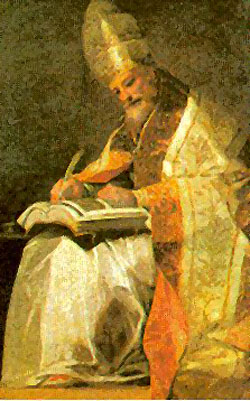
At an early age, he abandoned the chance to become a businessman, moved to Rome from Florence and devoted his life and individuality to God. After three years of philosophy and theology studies, he gave up any thought of ordination. The next 13 years were spent in a vocation unusual at the time—that of a layperson actively engaged in prayer and the apostolate.

As the Council of Trent was reforming the Church on a doctrinal level, Philip’s appealing personality was winning him friends from all levels of society, from beggars to cardinals. He rapidly gathered around himself a group of laypersons won over by his audacious spirituality. Initially they met as an informal prayer and discussion group, and also served poor people in Rome.

At the urging of his confessor, he was ordained priest and soon became an outstanding confessor, gifted with the knack of piercing the pretenses and illusions of others, though always in a charitable manner and often with a joke. He arranged talks, discussions and prayers for his penitents in a room above the church. He sometimes led “excursions” to other churches, often with music and a picnic on the way.

Some of his followers became priests and lived together in community. This was the beginning of the Oratory, the religious institute he founded. A feature of their life was a daily afternoon service of four informal talks, with vernacular hymns and prayers. Giovanni Palestrina was one of Philip’s followers, and composed music for the services.

The Oratory was finally approved after suffering through a period of accusations of being an assembly of heretics, where laypersons preached and sang vernacular hymns! (Cardinal Newman founded the first English-speaking house of the Oratory.)

Philip’s advice was sought by many of the prominent figures of his day. He is one of the influential figures of the Counter-Reformation, mainly for converting to personal holiness many of the influential people within the Church itself. His characteristic virtues were humility and gaiety.

Thursday, May 24, 2007

St Gregory VII, St Mary Magdalen of Pazzi, and St Bede the Venerable

St Gregory VII - from here: The tenth century and the first half of the eleventh were dark days for the Church, partly because the papacy was the pawn of various Roman families. In 1049, things began to change when Pope Leo IX, a reformer, was elected. He brought a young monk named Hildebrand to Rome as his counselor and special representative on important missions. He was to become Gregory VII.

Three evils plagued the Church then: simony (the buying and selling of sacred offices and things), the unlawful marriage of the clergy and lay investiture (kings and nobles controlling the appointment of Church officials). To all of these Hildebrand directed his reformer’s attention, first as counselor to the popes and later (1073-1085) as pope himself.

Gregory’s papal letters stress the role of bishop of Rome as the vicar of Christ and the visible center of unity in the Church. He is well known for his long dispute with Holy Roman Emperor Henry IV over who should control the selection of bishops and abbots.

Gregory fiercely resisted any attack on the liberty of the Church. For this he suffered and finally died in exile. He said, “I have loved justice and hated iniquity; therefore I die in exile.” Thirty years later the Church finally won its struggle against lay investiture.

St Mary Magdalen of Pazzi - a vow of virginity at age 10 and she's still called "the ecstatic saint"? - from here: Mystical ecstasy is the elevation of the spirit to God in such a way that the person is aware of this union with God and both internal and external senses are detached from the sensible world. Mary Magdalene de Pazzi was so generously given this special gift of God that she is called the "ecstatic saint."
She was born into a noble family in Florence in 1566. The normal course would have been for Catherine de Pazzi to have married wealth and enjoyed comfort, but she chose to follow her own path. At nine she learned to meditate from the family confessor. She made her first Communion at the then-early age of 10 and made a vow of virginity one month later. When 16, she entered the Carmelite convent in Florence because she could receive Communion daily there.

Catherine had taken the name Mary Magdalene and had been a novice for a year when she became critically ill. Death seemed near so her superiors let her make her profession of vows from a cot in the chapel in a private ceremony. Immediately after, she fell into an ecstasy that lasted about two hours. This was repeated after Communion on the following 40 mornings. These ecstasies were rich experiences of union with God and contained marvelous insights into divine truths.

As a safeguard against deception and to preserve the revelations, her confessor asked Mary Magdalene to dictate her experiences to sister secretaries. Over the next six years, five large volumes were filled. The first three books record ecstasies from May of 1584 through Pentecost week the following year. This week was a preparation for a severe five-year trial. The fourth book records that trial and the fifth is a collection of letters concerning reform and renewal. Another book, Admonitions, is a collection of her sayings arising from her experiences in the formation of women religious.

The extraordinary was ordinary for this saint. She read the thoughts of others and predicted future events. During her lifetime, she appeared to several persons in distant places and cured a number of sick people.

It would be easy to dwell on the ecstasies and pretend that Mary Magdalene only had spiritual highs. This is far from true. It seems that God permitted her this special closeness to prepare her for the five years of desolation that followed when she experienced spiritual dryness. She was plunged into a state of darkness in which she saw nothing but what was horrible in herself and all around her. She had violent temptations and endured great physical suffering. She died in 1607 at 41, and was canonized in 1669.

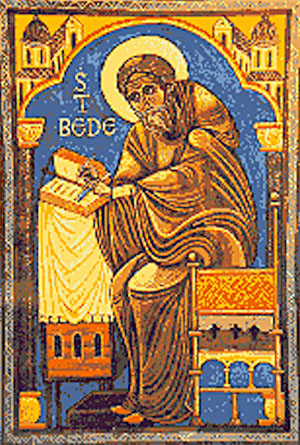
St Bede - from here: Bede is one of the few saints honored as such even during his lifetime. His writings were filled with such faith and learning that even while he was still alive, a Church council ordered them to be read publicly in the churches.

At an early age Bede was entrusted to the care of the abbot of the Monastery of St. Paul, Jarrow. The happy combination of genius and the instruction of scholarly, saintly monks produced a saint and an extraordinary scholar, perhaps the most outstanding one of his day. He was deeply versed in all the sciences of his times: natural philosophy, the philosophical principles of Aristotle, astronomy, arithmetic, grammar, ecclesiastical history, the lives of the saints and, especially, Holy Scripture. From the time of his ordination to the priesthood at 30 (he had been ordained deacon at 19) till his death, he was ever occupied with learning, writing and teaching. Besides the many books that he copied, he composed 45 of his own, including 30 commentaries on books of the Bible.

Although eagerly sought by kings and other notables, even Pope Sergius, Bede managed to remain in his own monastery till his death. Only once did he leave for a few months in order to teach in the school of the archbishop of York. Bede died in 735 praying his favorite prayer: “Glory be to the Father, and to the Son, and to the Holy Spirit. As in the beginning, so now, and forever.”

His Ecclesiastical History of the English People is commonly regarded as of decisive importance in the art and science of writing history. A golden age was coming to an end at the time of Bede’s death: It had fulfilled its purpose of preparing Western Christianity to assimilate the non-Roman barbarian North. Bede recognized the opening to a new day in the life of the Church even as it was happening.

cyber activism

Interesting article here about a guy who has taken a very different route to protesting the war and militarism, and providing a memorial for those who have died in it. Cyber activism at its best. From his website:
I am currently in the process of logging into the America's Army online game to input all of the names of each of the over 2000 [now almost 3400] American service persons who have been killed in the Iraq conflict, utilizing the game's instant texting feature. America's Army is the free, downloadable first person shooter game that serves as a primary recruiting mechanism for the United States Army.
Great nonviolent direct action.

Wednesday, May 23, 2007

Lyrical Spotlight: Screaming Jets (II)

Impossible

You can't do much about the
Governments policies
You can't do much about the heresies
You can't do too much to stop the squeeze on society
When you're all out of touch
You can't have much to say.

We can put a man on the moon
But we cant find a cure for starvation
Everybodys passing the buck
And there's no realisation

Well ain't it like being impossible
But there ain't no harm in tryin
Said ain't it like being impossible
But I'm gonna die trying

You can't do much about the birth of a new age
You can't do much about the old days
You can't do much about the equal and opposite reaction
You can't do much about that satisfaction

I don't know much about it
I didn't listen too much
There's no use in denying your piece of luck.

Ain't it like being impossible
There ain't any use in hiding
And I said hell man
Ain't this like being impossible
But I'm gonna die trying

You can't do much about what's gonna happen today
And you can't do much about yesterday
You can't say much against some
Angry individual
You can't say much against the majority

Is there any use shouting about it
Will anybody listen?
Will anybody back you up?
Is it gonna be your mission?

Well ain't it like being impossible
But there ain't no harm in trying
And I say hell man
Ain't this like being impossible
But I'm gonna die tryin'.

Tuesday, May 22, 2007

Gembrook NVDA training

Last weekend, the CAN crew headed down to Gembrook for a weekend of fun, frivolity and NVDA training. With both the peace convergence and trial of the Pine Gap Four fast approaching, it seemed like an appropriate time to do it. Here's the weekend in pictures.

The wombat very kindly made itself available to us. It's been sick but seems to be coming back to health.

The Wall prepares to receive yet another body.

Never say NVDA training is dull.

Gembrook is a pretty spectacular place to be at the moment.

The colours are absolutely amazing.

Some of the crew listening to some guy drone on and on.

Role-playing. Sandra Sully, Tracey Grimshaw, Mr Paul Tester and Ali.

St Rita of Cascia

Patron saint of lost causes...and the inspiration to persevere. From here: Daughter of Antonio and Amata Lotti; known as Peacemakers of Jesus, they had Rita late in life. From her early youth, Rita visited the Augustinian nuns at Cascia, and showed interest in a religious life. However, when she was twelve, her parents betrothed her to Paolo Mancini, an ill-tempered, abusive individual who worked as town watchman, and was dragged into the political disputes of the Guelphs and Ghibellines. Disappointed but obedient, Rita married him when she was 18, and was the mother of twin sons.

She put up with Paolo's abuses for eighteen years before he was ambushed and stabbed to death. Her sons swore vengeance on their father's killers, but through Rita's prayers and interventions, they forgave the offenders.

Upon the deaths of her sons, Rita again felt the call to religious life. However, some of the sisters at the Augustinian monastery were relatives of her husband's assassins, and she was denied entry for fear of causing dissension. Asking for the intervention of Saint John the Baptist, Saint Augustine of Hippo, and Saint Nicholas of Tolentino, she managed to bring the warring factions together, not completely, but sufficiently that there was peace, and she was admitted to the monastery of Saint Mary Magdalen at age 36.

Rita lived 40 years in the convent, spending her time in prayer and charity, and working for peace in the region. She was devoted to the Passion, and in response to a prayer to suffer as Christ, she received a chronic head wound that appeared to have been caused by a crown of thorns, and which bled for 15 years.

Confined to her bed the last four years of her life, eating little more than the Eucharist, teaching and directing the younger sisters. Near the end she had a visitor from her home town who asked if she'd like anything; Rita's only request was a rose from her family's estate. The visitor went to the home, but it being January, knew there was no hope of finding a flower; there, sprouted on an otherwise bare bush, was a single rose blossom.

Among the other areas, Rita is well-known as a patron of desperate, seemingly impossible causes and situations. This is because she has been involved in so many stages of life - wife, mother, widow, and nun, she buried her family, helped bring peace to her city, saw her dreams denied and fulfilled - and never lost her faith in God, or her desire to be with Him.

Monday, May 21, 2007

St Christopher Magallanes

From Wikipedia: Saint Cristóbal Magallanes Jara was born in Totatiche, Jalisco, Mexico on July 30, 1869. He was son of Rafael Magallanes and Clara Jara, who were farmers. He worked as a shepherd in his youth and enrolled in the Conciliar Seminary of San José in Guadalajara at the age of 19.

He was ordained at the age of 30 at the Santa Teresa Temple in Guadalajara and subsequently served as chaplain of the School of Arts and Works of the Holy Spirit in Guadalajara. He was then designated as the parish priest for his home town of Totatiche, where he helped found schools, carpentry shops and the planning of hydrological works including the dam of La Candelaria.

He took special interest in the evangelization of the local indigenous Huichol people and was instrumental in the foundation of the mission in the indigenous town of Azqueltán. When government decrees shut down the seminary in Guadalajara in 1914, he offered to open a seminary in his parish. In July of 1915, he opened the Auxiliar Seminary of Totatiche, which quickly achieved a student body of 17 students by the following year and was recognized by the Archbishop of Guadalajara, José Francisco Orozco y Jiménez, who appointed a precept and two professors to the seminary.

Magallanes Jara wrote and preached against armed rebellion, but was falsely accused of promoting the Cristero Rebellion in the area. Arrested on May 21, 1927 while en route to celebrate Mass at a farm, he gave away his few remaining possessions to his executioners, gave them absolution, and without a trial, he was martyred with Saint Agustín Caloca in Colotlán, Jalisco. His last words to his executioners were "I die innocent, and ask God that my blood may serve to unite my Mexican brethren."

He was succeeded as parish priest of Totatiche by José Pilar Quezada Valdés, who went on to become the first bishop of the diocese of Acapulco.

He was canonized by Pope John Paul II on May 21, 2000.