 From here: A native of Tuscany in Italy, John was elected Pope while he was still an archdeacon upon the death of Pope Hormisdas in 523. At that time, the ruler of Italy was Theodoric the Goth who subscribed to the Arian brand of Christianity, but had tolerated and even favored his Catholic subjects during the early part of his reign. However, about the time of St. John's accession to the Papacy, Theodoric's policy underwent a drastic change as a result of two events: the treasonable (in the sovereign's view) correspondence between ranking members of the Roman Senate and Constantinople and the severe edict against heretics enacted by the emperor Justin I, who was the first Catholic on the Byzantine throne in fifty years. Spurred on by the appeals of Eastern Arians, Theodoric threatened to wage war against Justin but ultimately decided to negotiate with him through a delegation of five Bishops and four senators. At its head he named Pope John - much against the latter's wishes. Little is known for certain about the nature of the message which the Pope bore and the manner in which he carried out his mission. What is known is that he succeeded in persuading the Emperor to mitigate his treatment of the Arians and thus avoid reprisals against the Catholics in Italy. The Pope's visit also brought about the reconciliation of the Western and Eastern Churches which had been plagued by a schism since 482 when Zeno's Henoticon had been published. However, Theodoric had been becoming more suspicious with each passing day. While waiting for the delegation to return, he ordered the execution of the philosopher Boethius and his father-in-law Symmachus on a charge of treason; and as he got word of the friendly relations between the Pope and the emperor, he concluded that they were plotting against him. Hence, on the delegation's return to the capitol city of Ravenna, Pope John was imprisoned by order of Theodoric and died a short time later as a result of the treatment he experienced there.
Friday, May 18, 2007
St Pope John I
From here: A native of Tuscany in Italy, John was elected Pope while he was still an archdeacon upon the death of Pope Hormisdas in 523. At that time, the ruler of Italy was Theodoric the Goth who subscribed to the Arian brand of Christianity, but had tolerated and even favored his Catholic subjects during the early part of his reign. However, about the time of St. John's accession to the Papacy, Theodoric's policy underwent a drastic change as a result of two events: the treasonable (in the sovereign's view) correspondence between ranking members of the Roman Senate and Constantinople and the severe edict against heretics enacted by the emperor Justin I, who was the first Catholic on the Byzantine throne in fifty years. Spurred on by the appeals of Eastern Arians, Theodoric threatened to wage war against Justin but ultimately decided to negotiate with him through a delegation of five Bishops and four senators. At its head he named Pope John - much against the latter's wishes. Little is known for certain about the nature of the message which the Pope bore and the manner in which he carried out his mission. What is known is that he succeeded in persuading the Emperor to mitigate his treatment of the Arians and thus avoid reprisals against the Catholics in Italy. The Pope's visit also brought about the reconciliation of the Western and Eastern Churches which had been plagued by a schism since 482 when Zeno's Henoticon had been published. However, Theodoric had been becoming more suspicious with each passing day. While waiting for the delegation to return, he ordered the execution of the philosopher Boethius and his father-in-law Symmachus on a charge of treason; and as he got word of the friendly relations between the Pope and the emperor, he concluded that they were plotting against him. Hence, on the delegation's return to the capitol city of Ravenna, Pope John was imprisoned by order of Theodoric and died a short time later as a result of the treatment he experienced there.

Thursday, May 17, 2007
Lyrical Spotlight: Bob Dylan
Eve of Destruction (Screaming Jets version)
The eastern world it is explodin',
Violence is flarin', and the bullets are loadin',
You're old enough to kill but not for votin',
You don't believe in war, what's that gun you're totin',
And even the Jordan river has bodies floatin',
And you tell me over and over and over again my friend,
Ah, you don't believe we're on the eve of destruction.
Don't you understand, what I'm trying to say?
Can't you feel the fears that I'm feeling today?
If the button is pushed, there's no running away,
There'll be no one to save with the world in a grave,
Take a look around you, boy, it's bound to scare you, boy,
And you tell me over and over and over again my friend,
Ah, you don't believe we're on the eve of destruction.
Yeah, my blood's so mad, feels like coagulatin',
I'm sittin' here, just contemplatin',
You can't twist the truth, it knows no regulation,
Handful of Senators don't pass legislation,
And marches alone won't bring innovation,
When human respect is disintegratin',
This whole f'ing world is just too frustratin',
And you tell me over and over and over again my friend,
Ah, you don't believe we're on the eve of destruction.
Think of all the hate there is in Red China!
Then take a look around at your own backyard!
Ah, you may leave here, for four days in space,
But when your return, it's the same old place,
They're poundin' out the drums, the fright and disgrace,
You can bury your dead, but don't leave a trace,
Hate your next-door-neighbour, but don't forget to say grace,
And you tell me over and over and over and over again my friend,
you don't believe we're on the eve of destruction.
you don't believe we're on the eve of destruction.
Ascension
 So today is the Ascension, and I could sure do with some. Just lots of stuff going on at the moment and I’m not feeling at all on top of it. Weary and not looking like a break soon…all really good stuff that I love, but just too much of it.
Acts 1:6 So when they had come together, they asked him, ‘Lord, is this the time when you will restore the kingdom to Israel?’ 7He replied, ‘It is not for you to know the times or periods that the Father has set by his own authority. 8But you will receive power when the Holy Spirit has come upon you; and you will be my witnesses in Jerusalem, in all Judea and Samaria, and to the ends of the earth.’ 9When he had said this, as they were watching, he was lifted up, and a cloud took him out of their sight. 10While he was going and they were gazing up towards heaven, suddenly two men in white robes stood by them. 11They said, ‘Men of Galilee, why do you stand looking up towards heaven? This Jesus, who has been taken up from you into heaven, will come in the same way as you saw him go into heaven.’
Somehow as if the call to “follow me” wasn’t enough, Jesus then takes off, leaving us to do the rest of the work…of course, it’s not quite that stark, and there’s as much a sense of empowerment in that as anything else...but I can see how the disciples might have felt a bit that way.
Wednesday, May 16, 2007
The Trouble With Our State by Daniel Berrigan
The trouble with our state
was not civil disobedience
which in any case was hesitant and rare.
Civil disobedience was rare as kidney stone
No, rarer; it was disappearing like immigrant's disease.
You've heard of a war on cancer?
There is no war like the plague of media
There is no war like routine
There is no war like 3 square meals
There is no war like a prevailing wind.
E-mail Alerts
To receive an e-mail notice when "On the Road to Peace" by John Dear, SJ is posted every week, sign up here for e-mail alerts.
It flows softly; whispers
don't rock the boat!
The sails obey, the ship of state rolls on.
The trouble with our state
-- we learned only afterward
when the dead resembled the living who resembled the dead
and civil virtue shone like paint on tin
and tin citizens and tin soldiers marched to the common whip
-- our trouble
the trouble with our state
with our state of soul
our state of siege
--
was
Civil
Obedience.
Monday, May 14, 2007
St Matthias
 Best known as the guy who replaced Judas in the twelve...talk about shoes to fill.
According to Acts 1:15-26, during the days after the Ascension, Peter stood up in the midst of the brothers (about 120 of Jesus’ followers). Now that Judas had betrayed his ministry, it was necessary, Peter said, to fulfill the scriptural recommendation: “May another take his office.” “Therefore, it is necessary that one of the men who accompanied us the whole time the Lord Jesus came and went among us, beginning from the baptism of John until the day on which he was taken up from us, become with us a witness to his resurrection” (Acts 1:21-22).
They nominated two men: Joseph Barsabbas and Matthias. They prayed and drew lots. The choice fell upon Matthias, who was added to the Eleven.
Matthias is not mentioned by name anywhere else in the New Testament.Sunday, May 13, 2007
Christop Chwestions
Is Captain Feathersword nonviolent? (via text message)
Hey we were wondering what you think of smashing pinatas? (also via text message)
Me and Tomsy were wondering if you went into a restaurant with no money and ate there and then refused to pay would that qualify as civil disobedience?
(check out his blog here)
Saturday, May 12, 2007
Sts Nereus, Achilleus, Domitilla and Pancratius
 Not much is known of these...they died too early, and little information survived...except that they were likely to have been soldiers turned pacifists who were killed for their refusal to fight...from here:
The commemoration of these four Roman saints is made by the Church on 12 May, in common, and all four are named in the Proper of the Mass as martyrs. The old Roman lists, of the fifth century, and which passed over into the Martyrologium Hiernoymianum, contain the names of the two martyrs Nereus and Achilleus, whose grave was in the Catacomb of Domitilla on the Via Ardeatina; in the same calendar was found the name of St. Pancratius, whose body rested in a catacomb on the Via Aurelia.
Friday, May 11, 2007
The original Mothers' Day
 Proclaimed by Julia Ward Howe in 1870, Mothers' Day was originally a call for war to cease. The proclamation below eloquently spells out her reasoning.
Ironically, she is better known for penning the words to "Battle Hymn of the Republic", which has been interpreted as one of the most staunchly militaristic songs in the Christian tradition. Yet in actual fact it majors on the grace of God in the face of militarism - our God is marching on.
But below is the her original Mothers' Day proclamation. Let this be our call for those who still find themselves involved in war this Sunday - husbands, fathers, sons, daughters, mothers and wives.
Arise, then, women of this day!Amen.
Arise, all women who have hearts,
Whether our baptism be of water or of tears!
Say firmly:
"We will not have great questions decided by irrelevant agencies,
Our husbands will not come to us, reeking with carnage, for caresses and applause.
Our sons shall not be taken from us to unlearn
All that we have been able to teach them of charity, mercy and patience.
We, the women of one country, will be too tender of those of another country
To allow our sons to be trained to injure theirs."
From the bosom of the devastated Earth a voice goes up with our own.
It says: "Disarm! Disarm! The sword of murder is not the balance of justice."
Blood does not wipe out dishonor, nor violence indicate possession.
As men have often forsaken the plough and the anvil at the summons of war,
Let women now leave all that may be left of home for a great and earnest day of counsel.
Let them meet first, as women, to bewail and commemorate the dead.
Let them solemnly take counsel with each other as to the means
Whereby the great human family can live in peace,
Each bearing after his own time the sacred impress, not of Caesar,
But of God.
In the name of womanhood and humanity, I earnestly ask
That a general congress of women without limit of nationality
May be appointed and held at someplace deemed most convenient
And at the earliest period consistent with its objects,
To promote the alliance of the different nationalities,
The amicable settlement of international questions,
The great and general interests of peace.
John Dear on the refusal to vote
Of course, he's in a country where voting is not compulsory; and after his Plowshares action, he's ineligible to vote anyway. But this passage from his book "Peace Behind Bars" still makes me wonder whether as Christians we should vote at all...
The Gospel of Mark calls for "new wine in new wineskins." This "newness" led us to discuss the need for an entirely new society, a new way of living as the human family. "The Gospel is about nonviolent revolution," Dr King used to say. What are the ingredients of this nonviolent revolution, this new human society? The Gospel makes it plain: nonviolence, voluntary poverty, resistance to evil, community, prayer, hospitality, solidarity and care for the earth. This new nonviolent revolution rules out reform. Jesus doesn't stand for reform: he is about personal and social nonviolent revolution. The three of us [Bruce, Philip Berrigan are in prison together for the Pax Christi Spirit of Life Plowshares action] do not vote or seek public office. People often explode with anger when I tell them that like Dorothy Day and Thomas Merton, I’m a Christian anarchist. They are not too upset that I go to jail or risk my life living in an violent inner-city neighborhood or travel into the war zones of El Salvador or Haiti, but when I mention that I don’t vote, people get apoplectic. Bruce explains it this way: 1) He votes with his life; everyday, especially in jail, he tells his government what he thinks; 2) voting is “the opiate of the masses.” People think that all they have to do in a democracy is vote; actually voting every four years and not doing anything else is the antithesis of democracy. 3) Voting is about real choices, but we are never offered any real choices. We might be able to vote whether we want 22,000 nuclear weapons or 21,000 nuclear weapons, but we will never be allowed to vote for total nuclear disarmament. A few years ago, we could vote to spend $40 million or $90 million to the death squad government of El Salvador. That is not a choice. As Clarence Jordan said, “We don’t want to shuffle the deck; we want a whole new deck.” New wine and new wineskins!
Tuesday, May 08, 2007
More MLK gold
Jesus gave us a new norm of greatness. If you want to be important—wonderful. If you want to be recognized—wonderful. If you want to be great—wonderful. But recognize that he who is greatest among you shall be your servant. That's a new definition of greatness.
And this morning, the thing that I like about it: by giving that definition of greatness, it means that everybody can be great, because everybody can serve. You don't have to have a college degree to serve. You don't have to make your subject and your verb agree to serve. You don't have to know about Plato and Aristotle to serve. You don't have to know Einstein's theory of relativity to serve. You don't have to know the second theory of thermodynamics in physics to serve. You only need a heart full of grace, a soul generated by love. And you can be that servant.
--From The Drum Major Instinct, a sermon by MLK Jr.
MLK Jr.: Prophet of Peace
From his Letter from a Birmingham Jail:
"There was a time when the church was very powerful in the time when the early Christians rejoiced at being deemed worthy to suffer for what they believed. In those days the church was not merely a thermometer that recorded the ideas and principles of popular opinion; it was a thermostat that transformed the mores of society. Whenever the early Christians entered a town, the people in power became disturbed and immediately sought to convict the Christians for being "disturbers of the peace" and "outside agitators"' But the Christians pressed on, in the conviction that they were "a colony of heaven," called to obey God rather than man. Small in number, they were big in commitment. They were too God intoxicated to be "astronomically intimidated." By their effort and example they brought an end to such ancient evils as infanticide, and gladiatorial contests.Talk about prophetic. I'm doing what i'm doing now precisely because the church has been dismissed (rightly, in my opinion) as an irrelevant social club. It is still true that unless the church becomes a thermostat that transforms the mores of society, it will continue to have no authenticity, and be dismissed as an irrelevant social club with no meaning for the twenty first century.
Things are different now. So often the contemporary church is a weak, ineffectual voice with an uncertain sound. So often it is an archdefender of the status quo. Far from being disturbed by the presence of the church, the power structure of the average community is consoled by the church's silent and often even vocal sanction of things as they are.
But the judgment of God is upon the church as never before. If today's church does not recapture the sacrificial spirit of the early church, it will lose its authenticity, forfeit the loyalty of millions, and be dismissed as an irrelevant social club with no meaning for the twentieth century. Every day I meet young people whose disappointment with the church has turned into outright disgust."
Friday, May 04, 2007
introverts of the world, unite!
If you're an extravert, check out this article because there are some things you need to know. If you're an introvert, check out the same article because, well, it's nice to know there are other people who understand and sympathise. Especially when they recommend two hours by yourself for every hour around people...heavenly!
Some highlights:
Some highlights:
How many people are introverts? I performed exhaustive research on this question, in the form of a quick Google search. The answer: About 25 percent. Or: Just under half. Or—my favorite—"a minority in the regular population but a majority in the gifted population."
Extroverts are easy for introverts to understand, because extroverts spend so much of their time working out who they are in voluble, and frequently inescapable, interaction with other people. They are as inscrutable as puppy dogs. But the street does not run both ways. Extroverts have little or no grasp of introversion. They assume that company, especially their own, is always welcome. They cannot imagine why someone would need to be alone; indeed, they often take umbrage at the suggestion. As often as I have tried to explain the matter to extroverts, I have never sensed that any of them really understood. They listen for a moment and then go back to barking and yipping.
The worst of it is that extroverts have no idea of the torment they put us through. Sometimes, as we gasp for air amid the fog of their 98-percent-content-free talk, we wonder if extroverts even bother to listen to themselves. Still, we endure stoically, because the etiquette books—written, no doubt, by extroverts—regard declining to banter as rude and gaps in conversation as awkward. We can only dream that someday, when our condition is more widely understood, when perhaps an Introverts' Rights movement has blossomed and borne fruit, it will not be impolite to say "I'm an introvert. You are a wonderful person and I like you. But now please shush."Thanks to Mark and Mary Hurst of the AAANZ for pointing me to the article.
Thursday, May 03, 2007
Sts Philip and James
 St Philip is someone we don't hear about very often. He doesn't rate much of a mention in the gospels, so it's worth tracking what we do know about him, and what is fabled of him. From here:
Like the brothers, Peter and Andrew, Philip was a native of Bethsaida on Lake Genesareth (John 1:44). He also was among those surrounding the Baptist when the latter first pointed out Jesus as the Lamb of God. On the day after Peter's call, when about to set out for Galilee, Jesus met Philip and called him to the Apostolate with the words, "Follow me". Philip obeyed the call, and a little later brought Nathaniel as a new disciple (John 1:43-45). On the occasion of the selection and sending out of the twelve, Philip is included among the Apostles proper. His name stands in the fifth place in the three lists (Matthew 10:2-4; Mark 3:14-19; Luke 6:13-16) after the two pairs of brothers, Peter and Andrew, James and John. The Fourth Gospel records three episodes concerning Philip which occurred during the epoch of the public teaching of the Saviour:
* Before the miraculous feeding of the multitude, Christ turns towards Philip with the question: "Whence shall we buy bread, that these may eat?" to which the Apostle answers: "Two hundred penny-worth of bread is not sufficient for them, that every one may take a little" (vi, 5-7).
* When some heathens in Jerusalem came to Philip and expressed their desire to see Jesus, Philip reported the fact to Andrew and then both brought the news to the Saviour (xii, 21-23).
* When Philip, after Christ had spoken to His Apostles of knowing and seeing the Father, said to Him: "Lord, shew us the Father, and it is enough for us", he received the answer: "He that seeth me, seeth the Father also" (xiv, 8-9).
These three episodes furnish a consistent character-sketch of Philip as a naïve, somewhat shy, sober-minded man. No additional characteristics are given in the Gospels or the Acts, although he is mentioned in the latter work (i, 13) as belonging to the Apostolic College.
The second-century tradition concerning him is uncertain, inasmuch as a similar tradition is recorded concerning Philip the Deacon and Evangelist -- a phenomenon which must be the result of confusion caused by the existence of the two Philips. In his letter to St. Victor, written about 189-98, bishop Polycrates of Ephesus mentions among the "great lights", whom the Lord will seek on the "last day", "Philip, one of the Twelve Apostles, who is buried in Hieropolis with his two daughters, who grew old as virgins", and a third daughter, who "led a life in the Holy Ghost and rests in Ephesus." On the other hand, according to the Dialogue of Caius, directed against a Montanist named Proclus, the latter declared that "there were four prophetesses, the daughters of Philip, at Hieropolis in Asia where their and their father's grave is still situated." The Acts (xxi, 8-9) does indeed mention four prophetesses, the daughters of the deacon and "Evangelist" Philip, as then living in Caesarea with their father, and Eusebius who gives the above-mentioned excerpts (Hist. Eccl., III, xxxii), refers Proclus' statement to these latter. The statement of Bishop Polycrates carries in itself more authority, but it is extraordinary that three virgin daughters of the Apostle Philip (two buried in Hieropolis) should be mentioned, and that the deacon Philip should also have four daughters, said to have been buried in Hieropolis. Here also perhaps we must suppose a confusion of the two Philips to have taken place, although it is difficult to decide which of the two, the Apostle or the deacon, was buried in Hieropolis. Many modern historians believe that it was the deacon; it is, however, possible that the Apostle was buried there and that the deacon also lived and worked there and was there buried with three of his daughters and that the latter were afterwards erroneously regarded as the children of the Apostle. The apocryphal "Acts of Philip," which are, however purely legendary and a tissue of fables, also refer Philip's death to Hieropolis. The remains of the Philip who was interred in Hieropolis were later translated (as those of the Apostle) to Constantinople and thence to the church of the Dodici Apostoli in Rome.
And then there's James, who we know only a very little bit about; and what we do know is utterly confused since there are several James'. From his Wikipedia entry:
James, son of Alphaeus was one of the Twelve Apostles of Jesus of Nazareth. He is mentioned only briefly in the Synoptic Gospels, and there is no consensus about which other references to "James" in the New Testament refer to the son of Alphaeus.

"The son of Alphaeus" appears in the slightly varying lists of the Twelve Apostles provided by the Synoptic Gospels, as well as in the Acts of the Apostles. James is the son of Alphaeus and a brother of the Apostle Matthew, also known as Levi.
James is clearly distinguished from James, son of Zebedee, also called James the Greater, another one of the Twelve Apostles, but he is often identified with two other figures of the same name:
1. James the Less, who appears only in reference to his mother Mary in Mark 15:40, Mark 16:1, Matthew 27:56 This identification was convenient as it juxtaposed the two Apostles called James as Jacobus Maior and Jacobus Minor. However, it also made it imperative to identify Clopas, the husband of Mary, with Alphaeus, the father of the Apostle James. This identification was almost universally accepted and therefore, tradition knows him also as Saint James the Less.
2. James the brother of Jesus, who served for thirty years as head of the Church at Jerusalem and was killed in 62 CE. The identification with the brother of Jesus was supported by Jerome and therefore widely accepted in the Roman Catholic Church, while Eastern Orthodox and Protestant churches tend to distinguish between "James son of Alphaeus" and "James the brother of the Lord".
Another tradition holds that James, though strongly clinging to Jewish law, was sentenced to death for having violated the Torah. He is reported to have been martyred by crucifixion at Ostrakine in Lower Egypt, where he was preaching the Gospel. A carpenter's saw is the symbol associated with him in Christian art because it is also noted that his body was later sawed to pieces.
Lyrical Spotlight; Screaming Jets
Better
This girl didn't know what happened
When she knocked upon my door
The things you had, the life you lived
All the dreams you had before.
Your eyes were facin' your heart and soul
You know they said it all
What happened on that day back then
The moment hurt us all
Now you can see the reason why not everyone's the same
And you don't have to please them, or try hard to save your name
They said you'd never get anywhere,
Well they don't care and it's just not fair
That you know, and I know better.
They said you'd never get anywhere,
Well they don't care and it's just not fair
That you know, and I know better.
(Yes I do)
Well the days go by and you wonder why, "is this really true?"
Your heart says "No" but your feelings show the poor baby never knew
But you and I, we knew deep down, that ain't really you
We always knew that it'd work out right and we could start anew
Now you can see the reason why not everyone's the same
And you don't have to please them, or try hard to save your name
They said you'd never get anywhere,
Well they don't care and it's just not fair
That you know, and I know better.
They said you'd never get anywhere,
Well they don't care and it's just not fair
That you know, and I know better.
Well things ain't always what they seem
So wake up and get outta your dreams
Things ain't always what they seem so wake up!
Well things ain't always what they seem
Wake up man, you're in my dreams!
Things ain't always...
Oh now you can see the reason why not everyone's the same
And you don't have to please them, or try hard
They said you'd never get anywhere,
Well they don't care and it's just not fair
That you know, and I know better.
They said you'd never get anywhere,
Well they don't care and it's just not fair
That you know, and I know better.
They said you'd never get anywhere,
Well they don't care and it's just not fair
That you know, and I know better
A one, two, three, four, they said you'd never get anywhere,
Well they don't care and it's just not fair
You're never gonna get anywhere
That's what they tell me
Never, never, never, never, never, never, never gonna get anywhere
They don't care, and that's not fair!
They said you'd never get anywhere
They don't care and it's just not fair
That you know, and I know
Wednesday, May 02, 2007
St Athanasius
 Most famous for defending the divinity of Jesus during the Arian controversy. Brian McLaren does a good accessible version of Athanasius' argument from On The Incarnation in his book The Secret Message of Jesus:
“Once upon a time there was a good and kind king who had a great kingdom with many cities. In one distant city, people took advantage of the freedom the king gave them and started doing evil. They profited by their evil and began to fear that the king would interfere and throw them in jail. Eventually these rebels seethed with hatred for the king. They convinced the city that everyone would be better off without the king, and the city declared its independence from the kingdom.
But soon, with everyone doing whatever they wanted, disorder reigned in the city. There was violence, hatred, lying, oppression, murder, rape, slavery and fear. The king thought: what should I do? If I take my army and conquer the city by force, the people will have to fight against me, and I’ll have to kill so many of them, and the rest will only submit through fear or intimidation, which will make them hate me and all I stand for even more. How does that help them – to be either dead or imprisoned or secretly seething with rage? But if I leave them alone, they’ll destroy each other, and it breaks my heart to think of the pain they’re causing and experiencing.
So the king did something very surprising. He took off his robes and dressed in the rags of a homeless wanderer. Incognito, he entered the city and began to living in a vacant lot near a garbage dump. He took up a trade – fixing broken pottery and furniture. Whenever people came to him, his kindness and goodness and fairness and respect were so striking that they would linger just to be in his presence. They would tell him their fears and questions, and ask his advice. He told them that the rebels had fooled them, and that the true king had a better way to live, which he exemplified and taught. One by one, then two by two, and then by the hundreds, people began to have confidence in him and live in his way.
Their influence spread to others, and the movement grew and grew until the whole city regretted its rebellion and wanted to return to the kingdom again. But, ashamed of their horrible mistake, they were afraid to approach the king, believing he would certainly destroy them for their rebellion. But the king-in-disguise told them the good news: he was himself the king, and he loved them. He held nothing against them, and he welcomed them back into his kingdom, having accomplished by a gentle, subtle presence what never could have been accomplished through brute force.”
Ah, the nonviolent God.
Tuesday, May 01, 2007
Pine Gap 4 nonviolence training

“To know, worship, love, embrace and follow the God of nonviolence is to become a people of nonviolence. In a world of violence, religion is about praxis, living a concrete peacemaking way of life. A theology of nonviolence must be lived. It is a theology of action. It requires focusing on the God of peace, accompanying (for Christians) the nonviolent Jesus, and taking public risks of love to end war and disarm the planet.” --John Dear
With the trial of the Pine Gap 4 coming up in late May, the Christian Activist Network has decided to put together a weekend of training and reflection on nonviolent Christian witness, particularly aimed at solidarity actions for the PG4. It will be a weekend of reflecting on the nonviolent life, death and resurrection of Jesus and our place in it, as well as practical training in nonviolent direct action.
Solidarity actions are being planned for May 29th (trial starts 2pm) and June 2nd (to coincide with Alice Springs vigil).
It is being held at the Indigenous Hospitality House's retreat centre, 215 East Beenak Road Gembrook on Saturday 19th and Sunday 20th May. It will begin at 10am Saturday and conclude at 5pm Sunday. Meals will be provided.
A suggested donation of $25 is requested.
Email Simon to book a place.
Feast of St Joseph the Worker
A consecration of the work of our hands (and feet, minds, etc.). From here: "Apparently in response to the “May Day” celebrations for workers sponsored by Communists, Pius XII instituted the feast of St. Joseph the Worker in 1955. But the relationship between Joseph and the cause of workers has a longer history. In a constantly necessary effort to keep Jesus from being removed from ordinary human life, the Church has from the beginning proudly emphasized that Jesus was a carpenter, obviously trained by Joseph in both the satisfactions and the drudgery of that vocation. Humanity is like God not only in thinking and loving, but also in creating. Whether we make a table or a cathedral, we are called to bear fruit with our hands and mind, ultimately for the building up of the Body of Christ."
Ralph David Abernathy and the Civil Rights Movement
 I've been reading And the Walls Came Tumbling Down, the autobiography of Ralph David Abernathy, Martin Luther King Jr's best friend and right hand man. It's a remarkable insight into Martin Luther King Jr. and the Civil Rights movement. But it's also a remarkable insight into the machinations behind black Southern Baptist churches in the 1950's...a hotbed of politics, backstabbing and skullduggery. (yes yes, "and how is that different to now?" I hear you say.)
Anyway, here's a story he tells about MLK Jr. before he came to Montgomery:
I was beginning to hope that he would be called to Dexter Avenue, though I knew enough about the politics of the congregation to know how unlikely that would be.Hahahaha. I found that hilarious. This next one, though, I found much, much less hilarious. David Abernathy is the minister at the First Baptist Church, but has been called away to a meeting in Atlanta when he gets a phone call from his wife saying their house had been bombed (with her and the children in it). Luckily none of them were harmed. He says this of Juanita's (his wife) story:
The chairman of the Board of Deacons had already made his choice, and the man he had anointed had preached a highly commendable sermon two weeks earlier. The rest of the board had concurred with the chairman’s judgment, and most of the congregation was likewise in agreement. Martin Luther King’s visit was no more than a formality in which everyone had to participate because the clerk of the church, Robert Nesbit, had insisted Martin be invited…Martin…was at his best, and at his best no one was more learned and eloquent.
His topic was “The Three Dimensions of a Complete Life,” and when he was finished, the congregation was in awe of him…the deacons who had been so certain in their decision before the service began were now just as certain that this new man was sent to them by heaven. The chairman of the board pounded the table and reminded them that they had already made a decision. They replied that it was their prerogative to change their minds. Besides, they pointed out, no final vote had been taken. The chairman insisted that they ratify the earlier decision immediately, and the board said they were not prepared to make such a move – not after hearing the three dimensions of a complete life.
They argued all afternoon about what to do and finally struck a compromise. The earlier candidate would be invited to preach a second sermon, after which the board would make their final decision. With that they adjourned.
The following Sunday the chairman’s candidate returned for a second appearance in the pulpit. He had been briefed about the nature of the situation, as was clear from the topic of his sermon, published on the bulletin board outside the church: THE FOUR DIMENSIONS OF A COMPLETE LIFE.
That fourth dimension did him in. By the time he was finished, the deacons and congregation knew they wanted Martin. When the chairman was confronted with this unanimity of opinion, he gave in and Martin got the call.
I found one detail of the story particularly chilling: her account of what had happened while we were talking on the telephone the second time. As she had been huddled in our bedroom, talking to me, suddenly the sky had flashed, and then she had heard a distant blast.Yikes. It's easy to glamorise the Civil Rights movement in some ways, but stuff like this must have been beyond bearable. Especially when you consider that the Montgomery Bus Boycott was over and won at this point. The bombings were pure retributive malevolence.
"What's that?" Juanita had asked, trembling with renewed terror.
A nearby policeman had looked down at his watch. Then looked back at her with a frozen face.
"That would be your First Baptist Church," he had said.
She had stared for a moment into the coldest eyes she had ever seen, and suddenly the full horror of the situation had dawned on her. The police had known all along. They were in on the plans. There would be no real investigation and no one would be arrested or indicted. And the same would have been true had she and the baby died.
Monday, April 30, 2007

Saturday, April 28, 2007
Sts Peter Chanel and St. Louis-Marie Grignion de Montfort
 The story of St Peter Chanel is a remarkable one of going the way of the cross. From here:
The protomartyr of the South Seas, St. Peter Chanel was born in 1803 at Clet in the diocese of Belley, France. His intelligence and simple piety brought him to the attention of the local priest, Father Trompier, who saw to his elementary education. Entering the diocesan Seminary, Peter won the affection and the esteem of both students and professors. After his ordination he found himself in a rundown country parish and completely revitalized it in the three year span that he remained there. However, his mind was set on missionary work; so, in 1831, he joined the newly formed Society of Mary (Marists) which concentrated on missionary work at home and abroad. To his dismay, he was appointed to teach at the seminary at Belley and remained there for the next five years, diligently performing his duties.
In 1836, the Society was given the New Hebrides in the Pacific as a field for evangelization, and the jubilant St. Peter was appointed Superior of a little band of missionaries sent to proclaim the Faith to its inhabitants. On reaching their destination after an arduous ten month journey, the band split up and St. Peter went to the Island of Futuna accompanied by a laybrother and an English layman, Thomas Boog. They were at first well received by the pagans and their king Niuliki who had only recently forbidden canabalism. However, the kings jealousy and fear were aroused when the missionaries learned the language and gained the people's confidence; he realized the adoption of the Christian Faith would lead to the abolition of some of the prerogatives he enjoyed as both highpriest and sovereign.
Finally, when his own son expressed a desire to be baptized, the king's hatred erupted and he dispatched a group of his warriors to set upon the saintly head of the missionaries. Thus, on April 28, 1841, three years after his arrival, St. Peter was seized and clubbed to death by those he had come to save. And his death brought his work to completion - within five months the entire island was converted to Christianity.
St. Louis-Marie Grignion de Montfort. From Wikipedia:
French priest and Catholic saint, born in 31 January 1673 at Montfort, ordained to the priesthood in Paris in June 1700, and died at Saint-Laurent-sur-Sèvre on 28 April 1716.
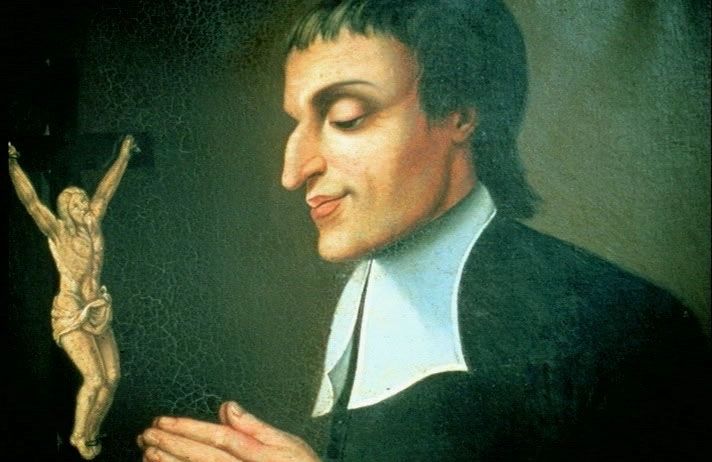
St. Louis was beatified by Pope Leo XIII in 1888 and canonized by Pius XII in 1947. His feast day is celebrated by the Church on 28 April.
The saint served as a missionary among the people of Brittany and the Vendee. His preaching in the Vendee contributed to it being the only region strongly resistant to the anti-clerical revolution of 1792.
St. Louis de Montfort was known for having directed the construction of a calvary among enthusiastic peasants. The King of France, however, under the influence of members of the Jansenist school, was later to order it destroyed. It is reported that upon receiving this disturbing news, he was not perturbed but only declared, "Blessed be God!" St. Louis' spirituality placed great emphasis on the value of obedience. However, he is best known for his promotion of Marian devotion.
Grignion de Montfort's approach of "total consecration to Jesus Christ through Mary" had a strong impact on Marian devotion both in popular piety and in the spirituality of religious orders.
The thought, writings, and example of St. Louis de Montfort, an example of the French school of spirituality, have been singled out in an encyclical by the late Pope John Paul II as a distinctive witness of Marian spirituality in the Catholic tradition; the pontiff also spoke of his reading the saint's work The True Devotion to Mary as a "turning point" in his life.
His popular book The Secret of the Rosary is approved by the Catholic church and is an easily readable, multi-perspective approach to the Holy Rosary that has been read by Catholics worldwide for over two centuries. "True Devotion to Mary" has been called the greatest Marian book of all time.
Subscribe to:
Posts (Atom)